What Schedule E is
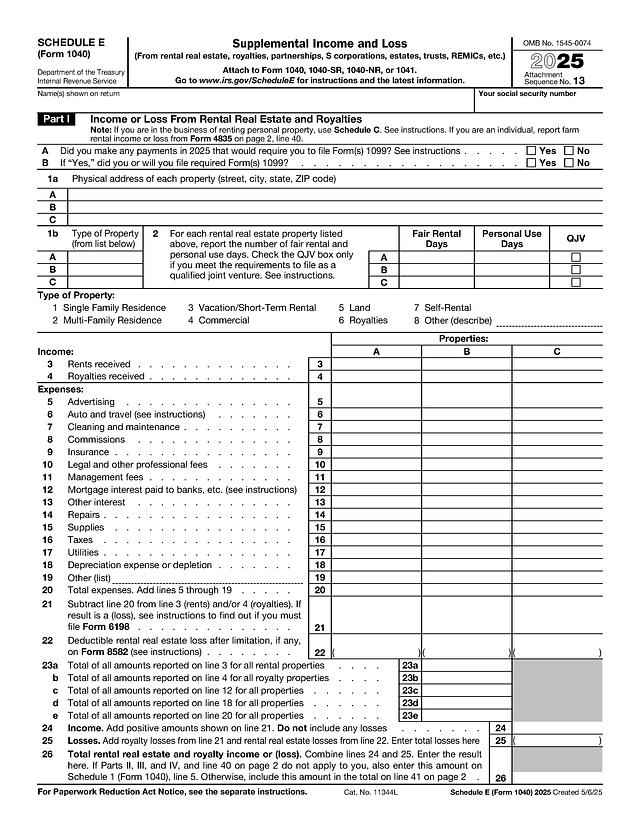
Schedule E (Form 1040), Supplemental Income and Loss, is the IRS schedule used to report income or loss from rental real estate, royalties, partnerships, S corporations, estates, trusts and REMIC residual interests. It is attached to Form 1040, 1040-SR, 1040-NR or 1041. This template is the 2025 version, two pages long, with 176 fillable fields. Page 1 covers rental real estate and royalties (Part I). Page 2 covers Parts II to V: partnerships and S corporations, estates and trusts, REMICs, and the summary.
Who typically needs it
- Landlords who rent out a house, apartment, vacation home, commercial unit or land.
- Owners of royalty interests, such as book, music or mineral royalties.
- Partners, S corporation shareholders and trust or estate beneficiaries who receive a Schedule K-1.
If you rent out personal property as a business, the form itself points you to Schedule C. Whether an activity counts as rental, passive or nonpassive is a tax question, so read the official Schedule E instructions or ask a tax professional.
What you need before you start
- Your name and Social Security number as shown on your return.
- The street address of each rental property and the number of days it was rented at fair rental value and used personally.
- Rent and royalty totals for the year, and receipts or statements for each expense category.
- Mortgage interest statements (Form 1098) and your depreciation figures.
- Any Schedule K-1 you received, with the name and EIN of each partnership, S corporation, estate or trust.
- Figures from Form 4562, Form 6198 or Form 8582 if they apply to you.
How to fill it out online with PDF Editify
Open this page, click "Fill Template Now" and the form opens in the editor with its fields ready. Click a field and type, tick the checkboxes, then sign if you need to and download. Downloading the finished PDF needs a plan: the One Week Plan is $3 one-time, Standard is $10 per month or $100 per year, and Lifetime starts at $99 one-time.
Top of page 1 and Part I, lines A to 2
Enter your name and Social Security number. Line A asks whether you made payments in 2025 that require Form 1099, and line B asks whether you filed or will file them. Mark Yes or No for each. On line 1a type the address of each property in columns A, B and C. On line 1b enter the property type code from the list printed on the form (1 single family residence, 2 multi-family residence, 3 vacation or short-term rental, 4 commercial, 5 land, 6 royalties, 7 self-rental, 8 other). On line 2 enter the fair rental days and personal use days per property, and tick QJV only if you meet the requirements in the instructions.
Income and expenses, lines 3 to 26
Line 3 is rents received and line 4 royalties received. Lines 5 to 19 are the expense categories, from advertising, auto and travel, cleaning and maintenance, commissions and insurance through mortgage interest, repairs, taxes, utilities and depreciation. Use line 19 for expenses not listed and describe them in the space provided. Enter each amount per property column. Line 20 totals the expenses, and line 21 subtracts line 20 from lines 3 and 4. Lines 22 to 26 carry limitation results, the totals in 23a to 23e, income and losses, and the combined result for Part I.
Part II, partnerships and S corporations
Answer line 27 Yes or No. On line 28 list each entity with its name, P or S, the foreign partnership box, EIN, and the basis and at-risk boxes. Then enter the passive and nonpassive amounts from your Schedule K-1 in columns (g) to (k). Lines 29 to 32 are totals.
Parts III to V
Part III (line 33 to 37) lists estates and trusts with their EIN and K-1 amounts. Part IV (lines 38 and 39) is for REMIC residual holders. Part V adds everything: line 40 is net farm rental income from Form 4835, line 41 is the total income or loss, and lines 42 and 43 are reconciliation lines.
Signing, and where and how to submit
Schedule E has no signature line of its own. You sign Form 1040, and Schedule E is filed with it. Per the instructions, Schedule K-1s are kept for your records and are not attached. Attach Form 4562 if you claim depreciation on new property, listed property, or a section 179 deduction. For the form and its instructions, see the IRS pages for Schedule E. If you also need a tool for signing other documents, see sign a PDF online.
Deadlines and fees
There is no fee to file Schedule E. As of November 12, 2026, the IRS lists April 15, 2026 as the due date for 2025 individual returns, with an automatic six-month extension available through Form 4868 (source: irs.gov, When to file). An extension gives more time to file, not to pay. If you have not filed yet, the IRS says to file as soon as possible. Check the IRS site for the schedule that applies to your tax year.
Common mistakes
- Entering the same property in different order on different lines, so columns A, B and C stop matching.
- Mixing up fair rental days and personal use days on line 2.
- Putting the figures in the wrong column when you have more than one property.
- Forgetting that mortgage interest on line 12 and depreciation on line 18 need support from statements or Form 4562.
- Typing a Schedule K-1 amount in a passive column when it belongs in a nonpassive one.
- Leaving off the Social Security number on page 2 and filing only half the form.
For other tax forms you may file with it, see what is an IRS 1040 form.