What Form 433-D is
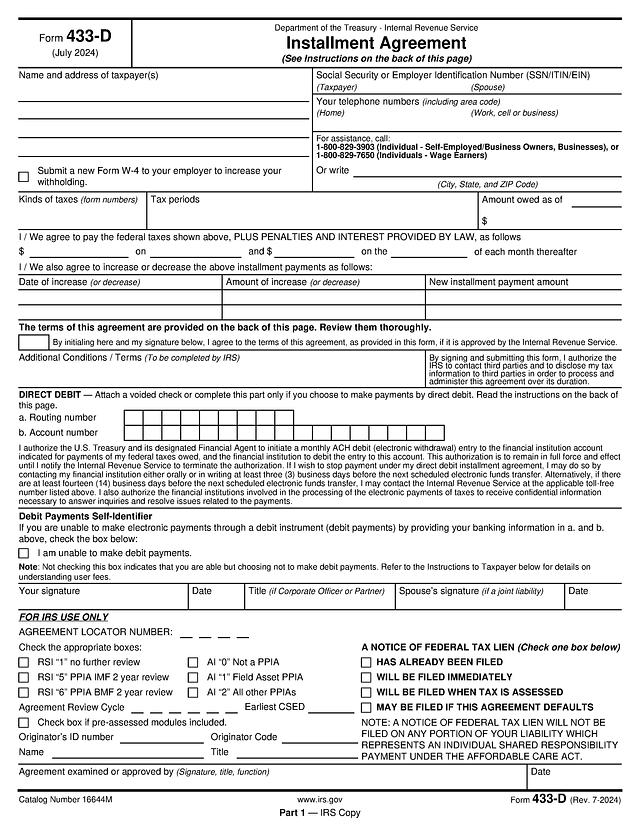
Form 433-D, Installment Agreement, is the document the IRS uses to finalize a monthly payment plan for taxes you owe. It is not the form you use to request a payment plan in the first place, that is Form 9465 or the IRS Online Payment Agreement tool. Form 433-D is the confirmation agreement: once the IRS has approved your terms, you (and your spouse, if the debt is joint) sign this form to lock in the monthly payment amount, the due date, and, if you choose it, direct debit from your bank account. The current revision is July 2024.
Who typically needs it
You will usually see Form 433-D after you have already requested an installment agreement, by mail with Form 9465, by phone with an IRS representative, or online through the Online Payment Agreement tool. The IRS, or sometimes your own financial institution, sends you a 433-D to sign so the agreement becomes official. It covers individual income tax balances (Form 1040), trust fund recovery penalties, and the individual shared responsibility payment. It is not used by businesses still accruing employment tax debt while operating, and it is not for anyone currently in bankruptcy.
What you need before you start
- The tax years and tax forms the balance covers, and the amount owed as shown on your IRS notice
- Your Social Security number, ITIN, or EIN, and your spouse's SSN if the liability is joint
- Your current address and phone numbers (home, and work, cell, or business)
- The monthly payment amount and due date (any day from the 1st to the 28th) that the IRS has already agreed to
- Your bank routing and account number if you are setting up direct debit, since it lowers both the setup fee and the risk of a missed payment
How to fill it out online with PDF Editify
Open the template, click "Fill Template Now," and the form loads in the editor with every field ready to type into. Work through it in order:
Taxpayer information. Enter your name, address, and SSN/ITIN/EIN in the first block, plus your spouse's SSN if you are filing jointly. Add your home and work or cell phone numbers.
Kinds of taxes and amount owed. List each tax form number (for example 1040) and the tax periods it covers, then the total amount owed as of the date on your IRS notice. These numbers should match what the IRS already quoted you, not a new calculation.
Payment terms. Fill in the first payment amount and date, then the recurring monthly amount and the day of the month it is due. If your plan includes a scheduled increase or decrease later, use the row for the date, the amount of change, and the new installment amount.
Direct debit section. If you are paying by direct debit, enter your bank's routing number on line a and your account number on line b. If you cannot make electronic payments, check the box confirming you are unable to make debit payments instead of leaving it blank.
Initial and sign. There is an initial box confirming you accept the terms on the back of the form, then signature and date fields for you and, if applicable, your spouse. If you are signing on behalf of a corporation or partnership, fill in your title as well.
Signing and where to submit
PDF Editify lets you draw, type, or upload a signature directly on the form. Once signed, download the PDF and return it the way the IRS instructed, typically by mailing it to the address on the letter that came with your agreement, or the address listed in the "For assistance" box on the form itself. If a representative is finalizing the agreement with you by phone, they may ask you to fax or upload the signed copy instead. Keep Part 2, the taxpayer's copy, for your own records.
Deadlines and fees (as of October 4, 2026)
There is no filing deadline for Form 433-D itself, since you only receive it after your installment agreement terms are already set. The setup fees that apply when the agreement is established are $107 for a direct debit agreement set up by mail, phone, or in person, or $29 if set up online. A non-direct-debit agreement costs $178 by mail, phone, or in person, or $69 online. Low-income taxpayers (generally at or below 250% of the federal poverty guidelines) pay a reduced $43 fee, which is waived entirely if they agree to direct debit. If an agreement defaults and the IRS reinstates it, the form lists an $89 reinstatement fee, reduced to $43 for low-income taxpayers. Fees are set by the IRS payment plans page, check it for the current amounts before you pay.
Common mistakes
- Leaving the payment due date blank or picking a day after the 28th, which the IRS cannot process on a fixed monthly cycle
- Entering a payment amount that does not match what was already approved, which can delay or reject the agreement
- Only one spouse signing when the tax liability is joint
- Writing in a deposit slip's internal routing number instead of calling the bank to confirm the actual ABA routing number
- Mailing Part 1 to the wrong address because the taxpayer used a generic IRS address instead of the one printed on their own notice or this form