What Form 8949 is
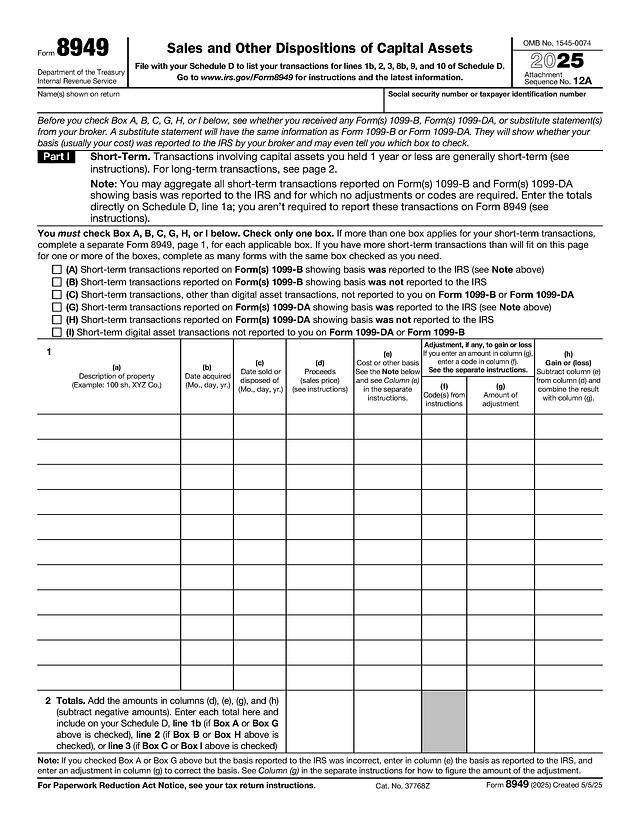
Form 8949, Sales and Other Dispositions of Capital Assets, is where you list individual sales of stocks, funds, digital assets and other capital assets, so the totals can be carried to Schedule D. The IRS About Form 8949 page describes its purpose as reconciling the amounts reported to you and the IRS on Forms 1099-B or 1099-S (or substitute statements) with what you report on your return. This template is the 2025 form, the latest version posted as of October 3, 2026.
The 2025 form is the first to separate digital assets. According to the 2025 Instructions for Form 8949, it adds boxes G, H and I for short-term digital asset transactions and boxes J, K and L for long-term ones, matching the new Form 1099-DA.
Who uses Form 8949
Individuals use it with Schedule D (Form 1040), and the instructions note that corporations, partnerships, estates and trusts use it with their own Schedule D. You need it when you sold or exchanged capital assets in 2025, for example shares from a brokerage account, crypto or other digital assets, or property you inherited. If you received a Form 1099-DA or Form 1099-B, start from those statements.
What to have ready
- All 2025 Forms 1099-B and 1099-DA, or your broker's substitute statements
- Purchase and sale dates for each item
- Your cost basis records, especially for anything your broker did not report basis on
- Details of any adjustments, such as wash sales or selling costs not shown on the 1099
How to fill out Form 8949 online
Click "Fill Template Now", type each transaction into the table, and download the PDF to attach to your paper return with Schedule D. If you have more transactions than fit, open the template again and fill another copy with the same box checked.
Header
Enter the name(s) shown on your return and your Social Security number or taxpayer identification number. Page 2 repeats these fields, but the form says they are not required there if shown on page 1.
Choosing a box
Each page needs exactly one box checked. Page 1 (Part I, short-term, generally held 1 year or less) has boxes A, B, C, G, H and I. Page 2 (Part II, long-term, generally held more than 1 year) has boxes D, E, F, J, K and L.
| Situation | Short-term | Long-term |
|---|---|---|
| Form 1099-B, basis reported to the IRS | A | D |
| Form 1099-B, basis not reported to the IRS | B | E |
| Not reported on 1099-B or 1099-DA (non-digital assets) | C | F |
| Form 1099-DA, basis reported to the IRS | G | J |
| Form 1099-DA, basis not reported to the IRS | H | K |
| Digital assets not reported on 1099-DA or 1099-B | I | L |
If more than one box applies, the form tells you to complete a separate page for each box.
Line 1: the transaction rows
Each page of this template has 11 rows with eight columns:
- (a) Description of property, for example "100 sh. XYZ Co."
- (b) Date acquired. The instructions allow "VARIOUS" for shares bought on different dates and "INHERITED" for inherited property.
- (c) Date sold or disposed of
- (d) Proceeds (sales price)
- (e) Cost or other basis
- (f) Adjustment code(s), such as B (basis shown on the 1099 is incorrect), E (selling costs not reflected) or W (nondeductible wash sale loss)
- (g) Amount of adjustment, with negative amounts in parentheses
- (h) Gain or (loss): column (d) minus column (e), combined with column (g)
Line 2: totals
Add columns (d), (e), (g) and (h) and carry the totals to Schedule D: line 1b, 2 or 3 for short-term (boxes A/G, B/H, C/I) and line 8b, 9 or 10 for long-term (boxes D/J, E/K, F/L).
When you can skip rows
The form notes that short-term and long-term transactions reported on Form 1099-B or 1099-DA with basis reported to the IRS, and needing no adjustments or codes, can be totaled directly on Schedule D, line 1a or 8a, instead of being listed here. The instructions also describe an option to report transactions on an attached statement with the same information and enter only the totals on Form 8949, using code M in column (f). E-filers send that statement with Form 8453. Check the instructions for the exact conditions.
Filing
Form 8949 is filed with your Schedule D and 2025 tax return by the return's due date, including extensions. It has no signature line of its own. If the basis your broker reported is wrong and you checked box A, D, G or J, the form says to enter the reported basis in column (e) and correct it with an adjustment in column (g).
Common mistakes
- Checking more than one box on a single page
- Putting digital asset sales under boxes A to F instead of G to L
- Entering an adjustment in column (g) without a code in column (f)
- Writing negative amounts with a minus sign instead of parentheses
- Totals on line 2 that do not match the Schedule D line for the checked box
Related forms are in our IRS tax form templates.