What Form G-28 is
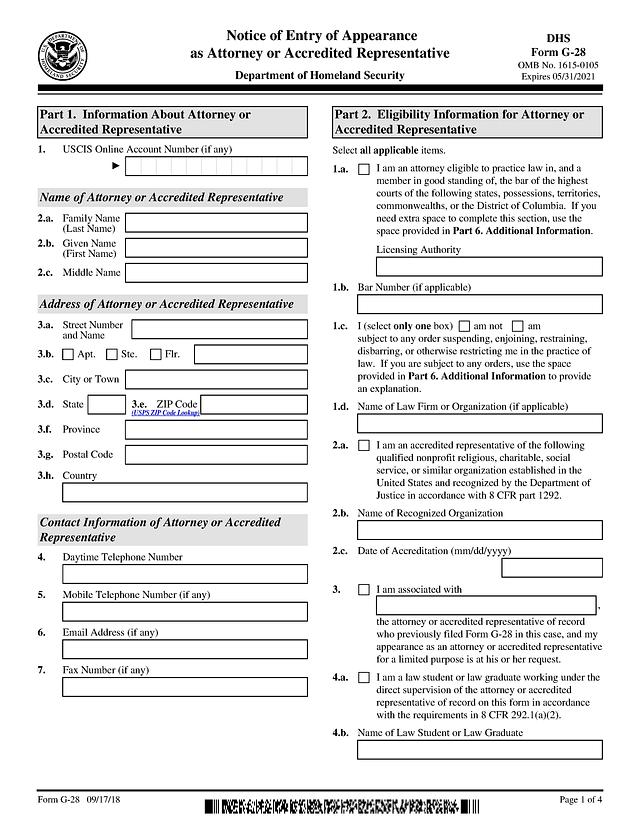
Form G-28, Notice of Entry of Appearance as Attorney or Accredited Representative, tells the U.S. Department of Homeland Security that a specific attorney or accredited representative represents a client in an immigration matter. This template is the 09/17/18 edition, four pages. The form shows an OMB expiration date of 05/31/2021, but as of October 3, 2026, the USCIS Form G-28 page lists 09/17/18 as the current edition and says the 09/17/18 and 05/23/18 editions may still be used despite the expiration date.
Who uses it
The attorney or accredited representative completes and submits the form, and the client signs a consent. A law student or law graduate working under the direct supervision of an attorney or accredited representative is listed on the same form. The form is published in English on the USCIS page; Spanish-speaking clients may need an interpreter to review the consent in Part 4.
In Part 3 the representative selects the agency the appearance relates to: USCIS, U.S. Immigration and Customs Enforcement (ICE), or U.S. Customs and Border Protection (CBP). For matters outside the United States, USCIS uses a separate form, Form G-28I.
What to have ready
- The representative's name, address, contact details, USCIS Online Account Number if any, and bar admissions with bar numbers, or the recognized organization and accreditation details.
- The client's full name, A-Number, USCIS Online Account Number, contact information, and mailing address.
- The form numbers or matter the appearance covers, and receipt numbers if the case is already pending.
How to fill it out with PDF Editify
Click "Fill Template Now", type into the fields, and download the completed PDF. The G-28 instructions say USCIS will not accept a stamped or typewritten name in place of a signature, and that the representative signs in black ink. A photocopied, faxed, or scanned copy of the original handwritten signature is acceptable. Print the form and sign by hand, then submit a scan or copy if filing online or mailing a copy.
Part 1. Information About Attorney or Accredited Representative
USCIS Online Account Number, name, business address, and daytime, mobile, email, and fax contact details.
Part 2. Eligibility Information
Select all that apply: attorney eligible to practice and in good standing (with licensing authority and bar number, and whether you are subject to any disciplinary order), accredited representative of a recognized organization, attorney or accredited representative associated with the representative who filed a previous G-28, or law student or law graduate working under supervision.
Part 3. Notice of Appearance
Choose USCIS, ICE, or CBP and list the form numbers, receipt number, or specific matter. Then enter the client's information: name, entity name if the client is a company, USCIS Online Account Number, A-Number, phone, email, and mailing address. The form asks for the client's mailing address, not the representative's, unless the representative's address is the safe mailing address on the filing.
Part 4. Client's Consent to Representation and Signature
The client consents to the representation and to disclosure of records, chooses how USCIS should send notices and secure identity documents, and signs and dates.
Parts 5 and 6
Part 5 is the signature of the attorney or accredited representative and, if applicable, the law student or graduate. Part 6, Additional Information, gives extra space with page, part, and item numbers.
Filing and fees
Per the USCIS G-28 page, file Form G-28 together with the related application, petition, motion, or appeal, in a USCIS online account or by mail. A later G-28 for a pending case can be submitted online for certain forms, or mailed to the office where the case is pending. The USCIS Fee Schedule (G-1055), edition 10/01/26, lists the G-28 filing fee as $0.
Common mistakes
USCIS says the most common mistake is a G-28 that is unsigned or missing a required signature. Others include:
- Leaving out the client's name or other required client information.
- Using a typed or stamped name instead of a handwritten signature.
- Mixing pages from different editions.
- Entering the representative's address as the client's mailing address.
Related forms are in our U.S. government forms collection, including Form I-485.