What Form I-130 is
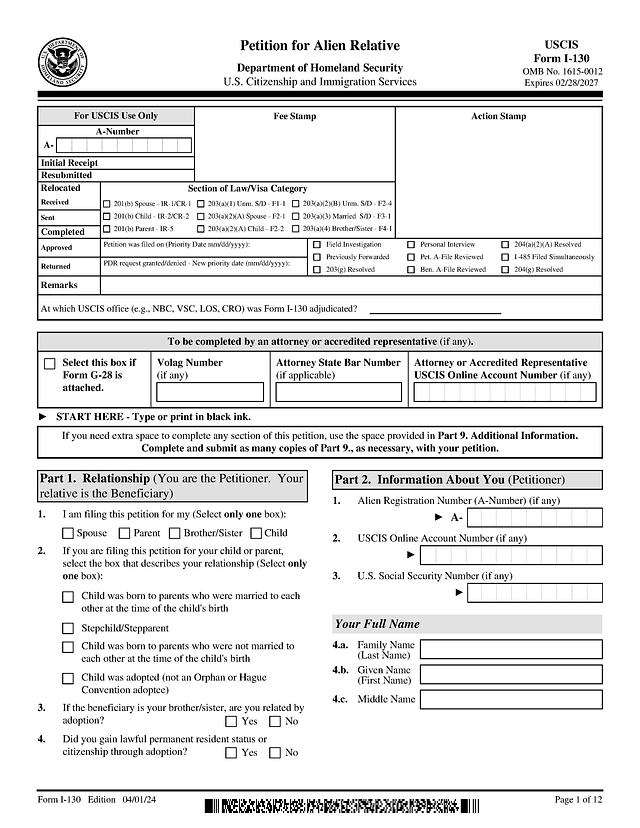
Form I-130, Petition for Alien Relative, is the U.S. Citizenship and Immigration Services (USCIS) form a U.S. citizen, lawful permanent resident, or U.S. national uses to establish a qualifying family relationship with a relative who wants to immigrate. The template on this page is the 12-page edition 04/01/24, which is the edition listed on the official USCIS Form I-130 page as of October 3, 2026. USCIS says it will reject a form if any pages are missing or come from a different edition, so check the edition date at the bottom of each page before you file.
Filing an I-130 only asks USCIS to recognize the relationship. It is one step in the family-based process, and the relative usually files other forms later. Whether a relationship qualifies is a legal question covered in the official instructions or by a qualified immigration attorney or accredited representative.
Who typically files it
- U.S. citizens petitioning for a spouse, child, parent, or brother or sister
- Lawful permanent residents petitioning for a spouse or unmarried child
USCIS asks for a separate I-130 for each relative, unless the relative can be treated as a derivative beneficiary. If you petition for a spouse, you must also submit Form I-130A, Supplemental Information for Spouse Beneficiary. That is a separate form and is not part of this template.
What to have ready
- Your A-Number, USCIS Online Account Number, and Social Security number, if you have them
- Your address history and employment history for the past five years
- Your marriage history (dates and places of each marriage and how it ended) and your parents' names, dates and places of birth
- The same kinds of details for your relative, plus their last arrival in the United States if they are here
- Proof of your status and proof of the relationship, as listed in the Form I-130 instructions
How to fill out Form I-130 online with PDF Editify
Click "Fill Template Now," type into the form fields in your browser, and download the completed PDF when you are done. Do not add an electronic signature for this form. Print it and sign by hand, as explained below.
Part 1. Relationship
Select how your relative is related to you (spouse, parent, brother or sister, or child) and answer the follow-up questions, such as whether a child was born in or out of wedlock, or whether you gained status through adoption.
Part 2. Information About You (Petitioner)
Enter your identification numbers, your full name and other names used, your place and date of birth, your mailing address, your physical addresses for the last five years, your marital history, details about your parents, and your employment for the last five years. Lawful permanent residents also answer the questions about how they obtained status.
Part 3. Biographic Information
Your ethnicity, race, height, weight, eye color, and hair color, all chosen from the checkboxes on the form.
Part 4. Information About Beneficiary
This is the longest part. It covers your relative's names, birth details, addresses, marital history, family members, immigration proceedings, last arrival, employment, and whether they will apply for adjustment of status in the United States or for an immigrant visa abroad.
Part 5. Other Information
Questions about any petitions you previously filed for this or other relatives.
Parts 6 to 9
Part 6 is your statement, contact information, and signature. Parts 7 and 8 are for an interpreter or a preparer, if someone helped you. Part 9 gives extra space for any answer that does not fit. Include your name and A-Number (if any) on additional sheets.
Signing and filing
USCIS does not accept typed names, computer-generated signatures, or a signature image pasted onto the form. According to the USCIS Policy Manual on signatures, a paper filing needs an original handwritten signature, although a photocopy or scan of a form that was signed by hand is accepted. Print the completed form, sign Part 6 in ink, and make copies for your records.
Where you send a paper I-130 depends on where you live and whether you are filing it together with other forms. USCIS lists the current lockbox addresses on its Direct Filing Addresses for Form I-130 page. USCIS also lets most petitioners file the I-130 online through a USCIS online account, and the online form collects your signature electronically. Check the I-130 page for when online filing is available to you.
Fees
USCIS fees change and can differ between paper and online filing. Look up the current amount on the USCIS Fee Schedule (Form G-1055), which had an edition date of 10/01/26 when we checked on October 3, 2026, before you pay.
Common mistakes
- Mixing pages from different editions, or leaving out pages you did not need to fill in
- Typing your name on the signature line or using an e-signature on a paper filing
- Forgetting Form I-130A when the beneficiary is your spouse
- Filing one petition for several relatives instead of one per person
- Leaving gaps in the five-year address or employment history
- Sending the petition to the wrong lockbox
For a longer walkthrough, see our Form I-130 guide, and browse related forms in U.S. government forms.