What the Illinois Complaint or Petition form is
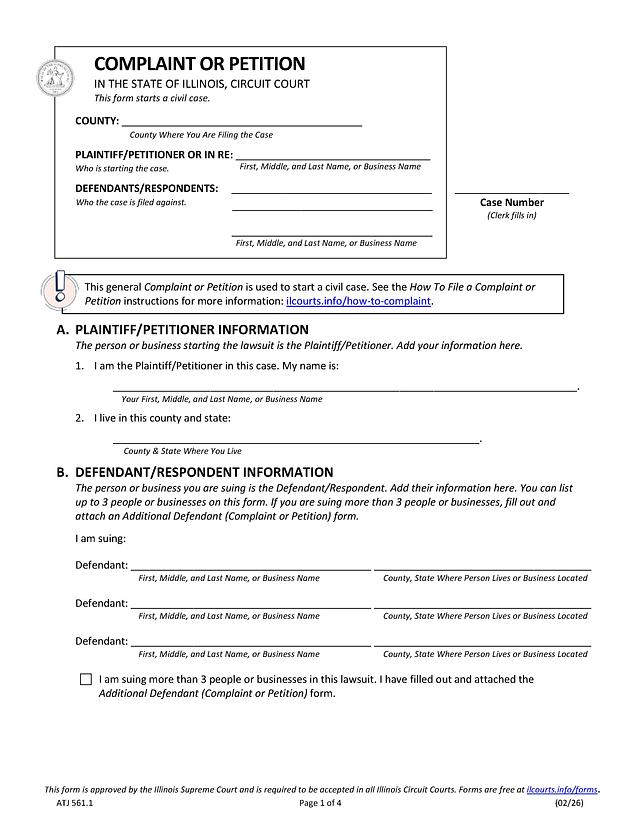
The Complaint or Petition (form ATJ 561.1, approved 02/2026) is the Illinois Supreme Court's general statewide form for starting a civil case in an Illinois Circuit Court. It names who is suing and who is being sued, explains the facts and legal reasons for the lawsuit, and tells the judge what you are asking for. The form states it must be accepted in all Illinois Circuit Courts, Cook County included. The official copy and its instructions are on the Illinois Courts Complaint or Petition page.
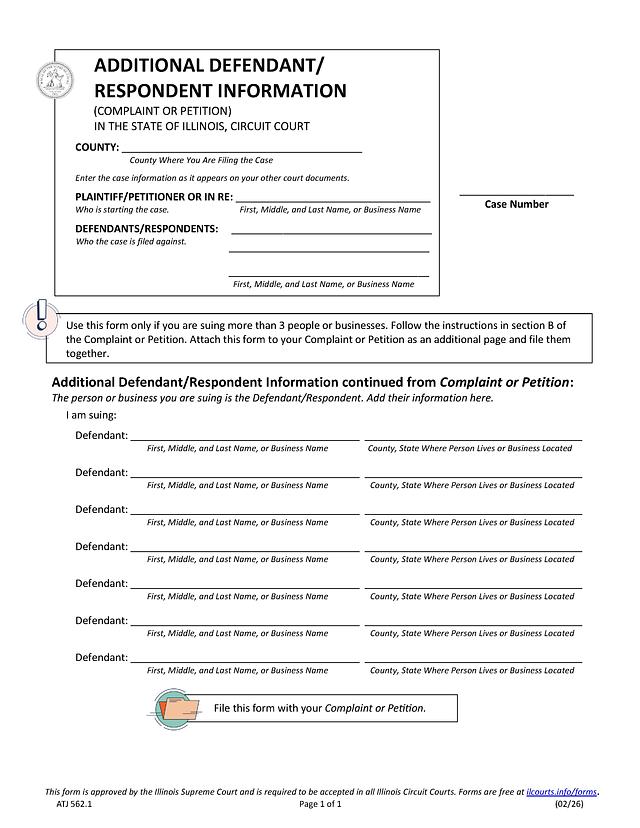
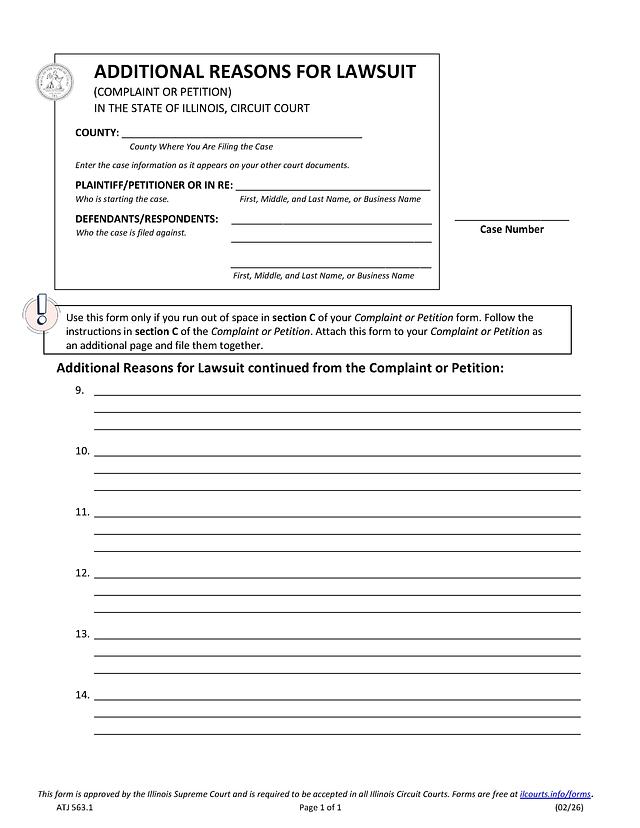
Two optional attachments go with this four-page form, filed together with it:
- Additional Reasons for Lawsuit, when you run out of numbered paragraphs in section C.
- Additional Defendant/Respondent Information, when you are suing more than 3 people or businesses.
When this form is used, and when it is not
According to the official How to File a Complaint or Petition instructions, this form is for civil cases that do not have their own complaint form. It is not for criminal, traffic, or juvenile cases. If you are asking for $10,000 or less and nothing else, the instructions direct you to the Small Claims Complaint instead. Divorce, eviction, name change, order of protection, and several other case types have their own forms at ilcourts.info/forms.
What to have ready
- The county where you will file. The instructions say this is usually where a defendant lives or where the events happened.
- Full names, or full legal business names, of each person or business you are suing, and the county and state where each is located.
- A dated list of key facts, any written document (such as a contract) the claim is based on, and what you are asking for.
How to fill it out online
Click "Fill Template Now", type into the fields, add your typed signature, and download the finished PDF to e-file. Here is what each section asks for.
Case caption (page 1)
Choose the County, then enter the Plaintiff/Petitioner or In Re name and the Defendants/Respondents. Leave Case Number blank, since the clerk fills it in.
A. Plaintiff/Petitioner Information
Your name or business name, and the county and state where you live.
B. Defendant/Respondent Information
Up to three defendants, each with the county and state where the person lives or the business is located. If there are more, check the box for the Additional Defendant form and attach it.
C. Reasons for Lawsuit (page 2)
Eight numbered paragraphs, one fact or issue each, with specific names, dates, places, and laws or rules. With several defendants, say which facts apply to each. Two checkboxes follow: one if you attached Additional Reasons for Lawsuit, and one if your lawsuit is based on a written document you attached.
D. What You Are Asking For (page 3)
Check all that apply: Pay me money (with an under or over $50,000 box and the exact amount), Return tangible personal property (describe the items), Pay the costs of this lawsuit, or Do something else. The form explains that checking an amount box and signing certifies the amount under Illinois Supreme Court Rule 222, with no separate affidavit needed. A jury trial is not automatic. If you want one, the form says to file a separate Jury Request at the same time.
Signature (page 4)
The form says you may sign online by typing your name after "/s/". Then print your name and check whether you are completing it for yourself (phone, email, address) or are a lawyer filing for a client (client name, attorney number, firm, contact details). The signature statement cites Rule 137 and, for money claims, perjury penalties under 735 ILCS 5/1-109. Our PDF signing tool also handles typed or drawn signatures.
Filing in Illinois: e-filing, exemptions, and fees
As of October 2026, the Illinois courts state that e-filing is mandatory in all civil cases in the Supreme, Appellate, and Circuit Courts (Illinois Courts e-filing information for filers without lawyers). The official instructions say most people e-file through Odyssey eFileIL at ilcourts.info/efile, which accepts PDF files, so the completed PDF you download is the kind of document you upload.
The instructions list people who do not have to e-file, such as self-represented people in prison or jail and people with a disability that keeps them from e-filing. Others may qualify for an exemption, for example if they have no internet or computer access at home, no email account, no credit card, debit card, or bank account, or trouble reading, writing, or speaking English. To ask for one, file the Certification for Exemption from E-Filing (ilcourts.info/exempt) with your forms at the Circuit Clerk's office or by mail.
There may be a filing fee, and it varies by county and case type, so check with your Circuit Clerk. If you cannot afford the costs, the instructions point to the statewide Application for Waiver of Court Fees at ilcourts.info/fee-waiver-forms.
After you file
Each defendant must be served with a Summons and the Complaint or Petition by the sheriff or a licensed private process server, not by you.
Common mistakes
- Using this general form when your case type has its own form, or for a claim of $10,000 or less that belongs in small claims.
- Using a nickname instead of a business's full legal name.
- Packing several facts into one paragraph.
- Asking for money without checking the under or over $50,000 box.
Illinois court self-help resources
- Illinois Courts Complaint or Petition form set, including the How to File a Complaint or Petition instructions.
- Illinois Court Help: call or text 833-411-1121, or visit ilcourthelp.gov.
- Illinois Legal Aid Online's directory of local legal self-help centers, plus its legal glossary.
These resources explain court procedure. They, and this page, cannot tell you whether you have a claim, what to ask for, or which law applies. For that, talk to a lawyer or a legal aid organization.