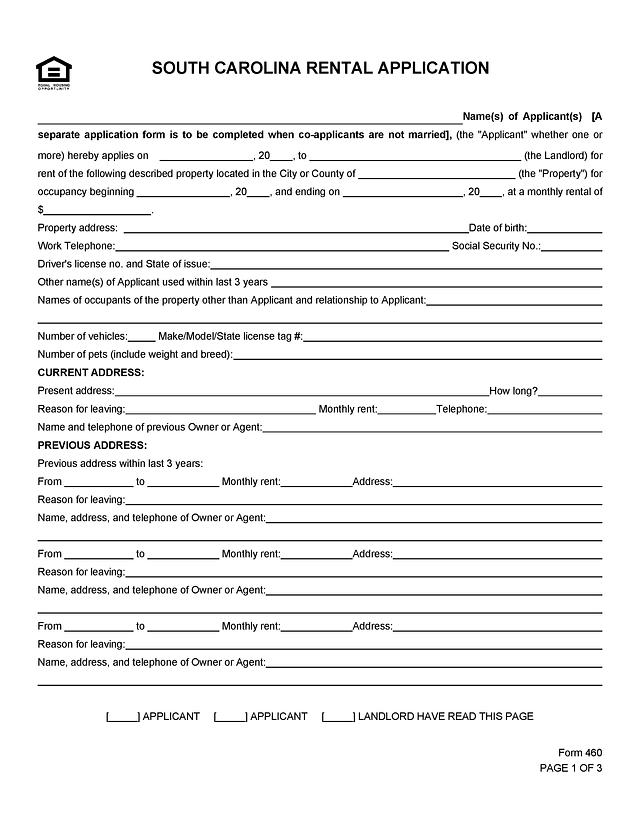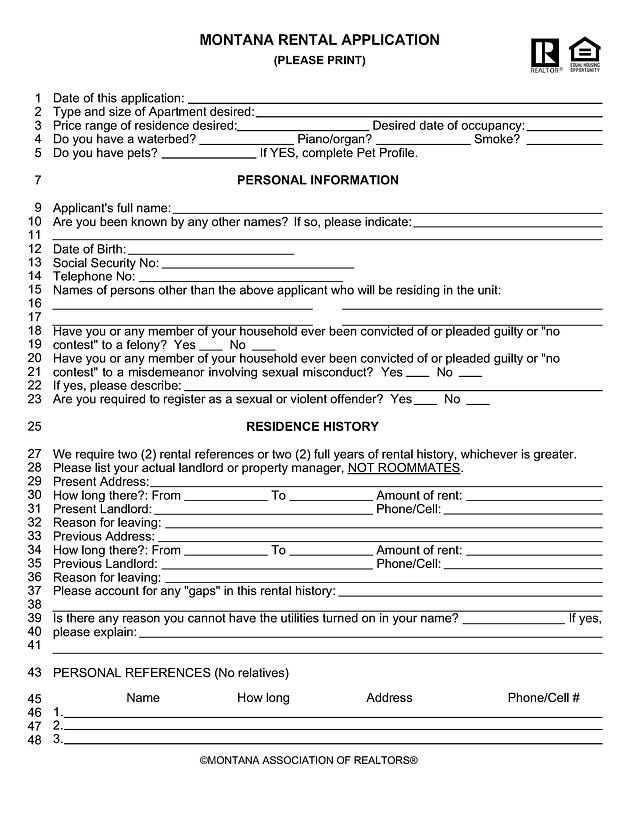
What this form is
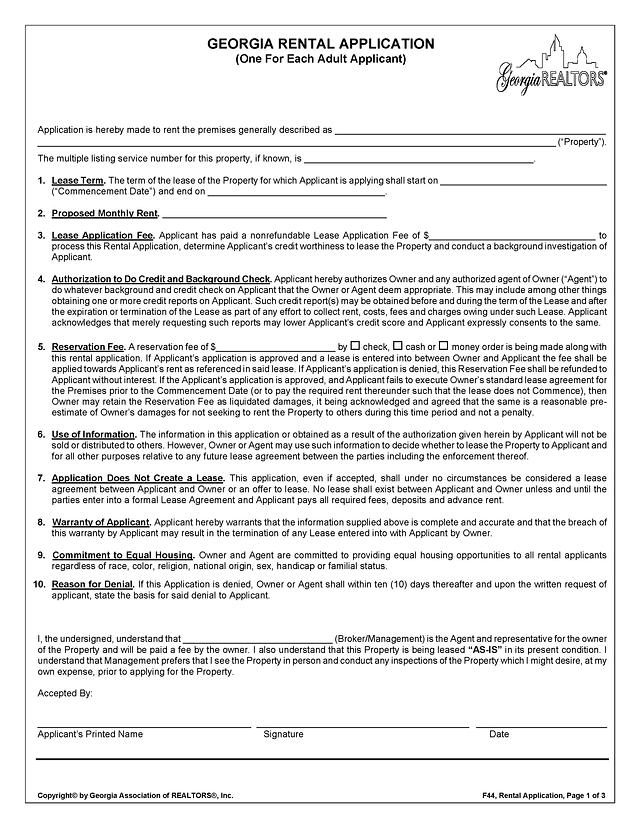
The Georgia Rental Application (Form F44) is a standard screening application published by the Georgia Association of REALTORS. It is a private industry template used by landlords, property managers and leasing agents across Georgia, not a government or court form. There is no state-issued "official" rental application in Georgia, so landlords and REALTORS commonly use this three-page form to collect an applicant's background, income and rental history before deciding whether to offer a lease.
Who typically needs it
Anyone applying to rent a house, apartment or condo in Georgia through a landlord, property manager or real estate agent who uses the GAR template. The form states it is "one for each adult applicant," so every adult who will be on the lease, including a spouse or partner, submits a separate copy.
What you need before you start
- The address of the property you want to rent and, if you have it, the MLS number
- Your Social Security number, date of birth and driver's license number and state
- Current and previous addresses with landlord names, phone numbers and the reason you left each one
- Current and previous employer details, including supervisor contact and annual income
- Immigration or citizenship documentation details if you are not a U.S. citizen
- The application fee and, if requested, a reservation fee, since the form asks you to confirm these were paid
How to fill it out online with PDF Editify
Open the Georgia Rental Application template page and click "Fill Template Now." The form opens with all 93 fields ready to type into. Fill the fields in order, sign, then download.
Page 1: Property and lease terms
Enter the property address and MLS number if known, the proposed lease start and end dates, the proposed monthly rent, and the lease application fee you paid. There is also a reservation fee section where you check whether you are paying by check, cash or money order. Read the authorization to run a credit and background check, then type the broker or management company name, your printed name, and sign and date the form.
Page 2: Applicant information and residence history
Check one of the two boxes about whether you have visited the property in person. Then complete section A, General: first, middle and last name, Social Security number, date of birth, driver's license number and state, phone numbers, email, emergency contact, and whether you have pets (with kind, number and weight). If you have a spouse or significant other who will also be on the lease, note that they must submit their own separate application. Section B, Residence History, asks for your current and, if applicable, previous address, how long you lived there, your current lease amount, and your landlord's name, phone and address, plus your reason for leaving. Initial at the bottom of the page.
Page 3: Employment and other matters
Section C, Employment, covers your current employer, position, address, supervisor, business phone, time at the job and annual income, with a second set of fields for a previous employer if relevant. Section D, Other Matters, asks whether you have a legal right to be in the United States (citizen, documented non-citizen, or no), with space for your visa type and expiration date if applicable. The form then asks a series of yes or no screening questions: whether you have ever been asked to move out of a residence, been party to an eviction, are a registered sex offender, own liquid furniture such as a waterbed, carry renter's insurance, have filed for bankruptcy, had a bankruptcy discharged or dismissed, or had any debt collection actions against you. Answer each honestly, since the form states you warrant that your information is complete and accurate. Initial again at the bottom.
Signing and returning it to the landlord
This form is not filed with any government office or court. Once you have completed and signed it, you return it directly to the landlord, property manager or leasing agent who gave it to you, usually along with your application fee and any requested reservation fee. You can sign electronically in the editor by drawing, typing or uploading a signature image; see our guide on how to sign a PDF for the different signing options.
Georgia rules on deposits and fees
Georgia law does not cap what a landlord can charge for a rental application fee, and this fee is separate from any security deposit (Georgia Department of Law, Consumer Protection Division, as of 2026-10-12). Once you have a lease and pay a security deposit, landlords who own more than 10 rental units must hold it in an escrow account or post a surety bond (O.C.G.A. 44-7-31, 44-7-32). After you move out, the landlord generally must return your deposit, or send a written itemized list of any deductions, within one month of the lease ending; failing to do so can forfeit the landlord's right to withhold any part of it (O.C.G.A. 44-7-34, 44-7-35, as of 2026-10-12). For fair housing, Georgia's state Fair Housing Act (O.C.G.A. 8-3-200 et seq.) protects the same classes as federal law: race, color, religion, sex, national origin, familial status and disability, and does not add further statewide categories. Within Atlanta city limits, local ordinance also prohibits discrimination based on source of income, which includes housing vouchers (City of Atlanta Code of Ordinances, Chapter 94, as of 2026-10-12). Always check the current statute or your local housing authority before relying on any of these details for a specific situation.
Common mistakes
- Leaving the Social Security number or date of birth blank, which can delay the background check
- Forgetting that each adult applicant, including a spouse or partner, needs a separate completed form
- Not listing a landlord's phone number or address, making it hard to verify your rental history
- Skipping the initials at the bottom of pages 2 and 3
- Answering the "Other Matters" screening questions inconsistently with what a background check will show
- Assuming this GAR template is a government form rather than a private document used at the landlord's discretion