What Form 4868 is
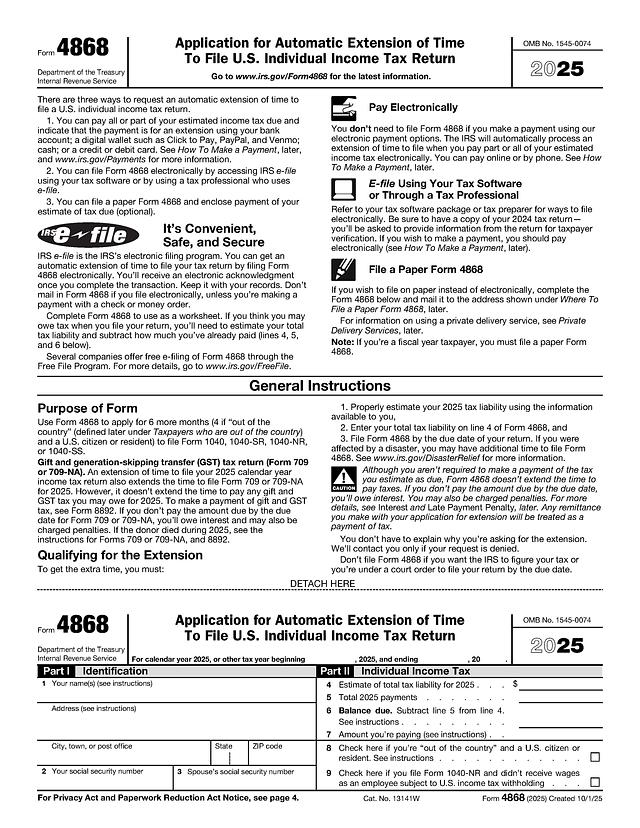
Form 4868, Application for Automatic Extension of Time To File U.S. Individual Income Tax Return, gives individuals extra time to file Form 1040, 1040-SR, 1040-NR, or 1040-SS. This template is the IRS 2025 edition, a 4-page PDF for 2025 tax returns. Page 1 holds the detachable form, and pages 2 to 4 hold the instructions and mailing addresses. As of October 3, 2026, it is the current final version on the IRS Form 4868 page.
The extension gives you 6 more months to file, or 4 more months if you are "out of the country" and a U.S. citizen or resident, since those filers already get 2 extra months. It is an extension to file, not to pay. Tax you owe is still due by the regular due date, and interest runs on anything paid later.
Who uses it
Individuals who need more time to finish their return use it. You do not have to give a reason, and the IRS says it will contact you only if the request is denied. According to the form, you should not file it if you want the IRS to figure your tax or if a court order requires you to file by the due date. Fiscal year taxpayers must file a paper Form 4868.
What to have ready
- Your name, your spouse's name if you plan to file jointly, and your current address.
- Your SSN and your spouse's SSN (or ITIN).
- An estimate of your total 2025 tax liability.
- The total of your 2025 payments so far: withholding, estimated tax payments, and credits.
- How much you plan to pay with the request, if anything.
How to fill out Form 4868 online
Click "Fill Template Now," type into the fields on page 1, and download the file to print or keep as a worksheet. The form has no signature line, so there is nothing to sign.
Tax year
Calendar year filers can leave the top line alone. Fiscal year filers enter the dates their tax year begins and ends.
Part I, Identification
Line 1 is your name or names, then address, city, state, and ZIP code. For a joint return, list both spouses in the order they will appear on the return. Line 2 is your SSN (the one shown first on a joint return), and line 3 is your spouse's SSN. If you don't have an ITIN and aren't eligible for an SSN, the instructions say to write "ITIN TO BE REQUESTED." A new address here does not update your IRS record. Use Form 8822 for that.
Part II, Individual Income Tax
- Line 4: estimate of total tax liability for 2025. Enter -0- if you expect none. The form warns that if your estimate turns out not to be reasonable, the extension is null and void.
- Line 5: total 2025 payments, not counting what you send with this form.
- Line 6: balance due, line 4 minus line 5 (not less than zero).
- Line 7: the amount you are paying now.
- Line 8: check if you are out of the country and a U.S. citizen or resident.
- Line 9: check if you file Form 1040-NR and didn't receive wages subject to U.S. income tax withholding.
Page 3 also has a box to record the confirmation number if you pay electronically.
How to submit it
There are three ways to get the extension: pay all or part of your estimated tax electronically and mark the payment as an extension payment, e-file Form 4868 with tax software or a tax professional, or mail a paper Form 4868. If you pay electronically and indicate it is for an extension, you don't need to file the form. Payment options are listed at IRS.gov/Payments.
For a paper filing, the address on page 4 depends on your state and whether you are enclosing a payment. With a payment, it goes to an IRS P.O. box in Charlotte, NC, or Louisville, KY. Without one, it goes to the Internal Revenue Service Center in Austin, Kansas City, or Ogden. Make checks payable to "United States Treasury." Don't attach a copy of Form 4868 to your return later.
Deadlines and penalties (2025 tax year)
For 2025 calendar year returns, the form says Form 4868 was due April 15, 2026, for most people, or June 15, 2026, for those out of the country. The extended filing deadline is October 15, 2026, for most calendar year taxpayers. As of October 3, 2026, the window to request a 2025 extension has closed for most filers, and anyone already on extension should file by October 15. Disaster-area taxpayers may have more time; see IRS.gov/DisasterRelief.
The form lists these penalties: the late payment penalty is usually 1/2 of 1% of unpaid tax for each month or part of a month, up to 25%. The late filing penalty is usually 5% per month, up to 25%, and if a return is more than 60 days late the minimum is $525 (adjusted for inflation) or the balance due, whichever is smaller.
For 2026 returns, use the 2026 edition of Form 4868 once the IRS releases it. As of this date, only a draft marked "not for filing" is posted.
Common mistakes
- Thinking the extension also delays payment. It doesn't.
- Leaving line 4 blank. The extension requires an estimate of total tax.
- Mailing both a paper form and an electronic extension payment when the payment alone would have done it.
- Sending the form to the "no payment" address while enclosing a check.
- Expecting a new address on Form 4868 to update your IRS records.
Read more in our complete Form 4868 guide.