What Form 8889 is
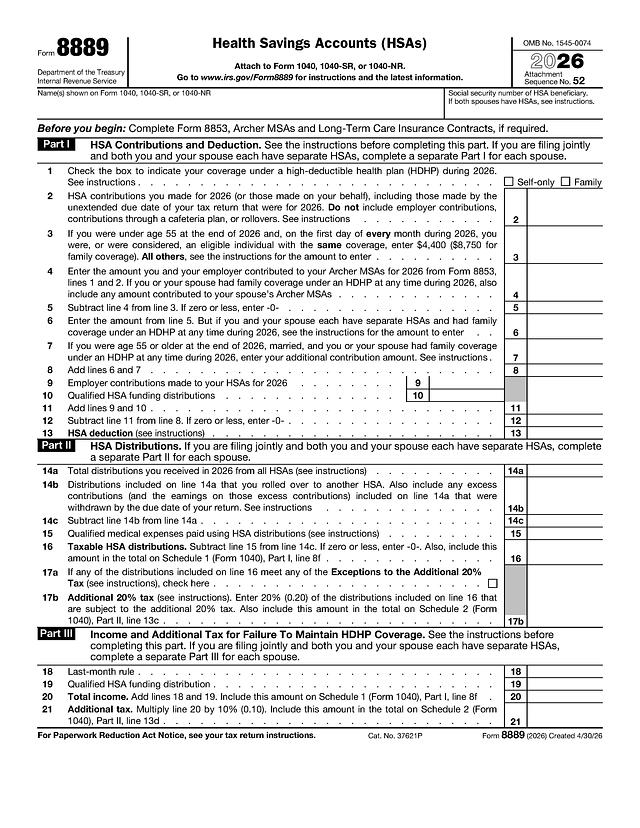
Form 8889, Health Savings Accounts (HSAs), is the Internal Revenue Service form that reports what went into your health savings account and what came out of it. It has three parts: contributions and the HSA deduction, distributions, and income plus additional tax when you stop meeting the high-deductible health plan (HDHP) requirements. It is attached to your Form 1040, 1040-SR or 1040-NR. The version on this page is for tax year 2026.
Who typically needs it
- Anyone who, or whose employer, put money into an HSA during the year.
- Anyone who took money out of an HSA. Per the IRS instructions, if you received HSA distributions you file the form even when none of it is taxable.
- People who lost HDHP coverage and must report income under the testing-period rules in Part III.
- Married couples who both have an HSA. If you file jointly, each spouse completes a separate Form 8889.
What you need before you start
- Your name and Social Security number as they appear on your return. The form asks for the number of the HSA beneficiary.
- The coverage you had under an HDHP in 2026: self-only or family.
- Form 5498-SA from your HSA trustee for contributions, and Form 1099-SA for distributions.
- Your W-2, where box 12 code W shows employer and cafeteria plan contributions.
- Records of qualified medical expenses paid with HSA money.
How to fill out Form 8889 online with PDF Editify
- Open this page and click Fill Template Now. The form opens in the editor with its fields ready to type into.
- Click a field and type. Use the check boxes for line 1 and line 17a.
- Download the finished PDF. Opening and filling does not need a card, but downloading needs a plan. If you also need to sign something, our sign PDF tool lets you draw, type or upload a signature.
Header
Enter the name or names shown on your return and the Social Security number of the HSA beneficiary. If both spouses have an HSA, prepare one form for each of them.
Part I: HSA contributions and deduction (lines 1 to 13)
- Line 1: tick Self-only or Family for your HDHP coverage.
- Line 2: contributions you made yourself, or that were made for you, for 2026. The form says not to include employer contributions, cafeteria plan contributions or rollovers.
- Line 3: the limit. The form prints $4,400 for self-only and $8,750 for family coverage for people under 55 with the same coverage every month. Everyone else follows the instructions for the amount.
- Lines 4 to 6: Archer MSA contributions from Form 8853, then the subtraction and carry-over of the limit.
- Line 7: the additional contribution amount, only for people age 55 or older who meet the conditions on the form.
- Lines 9 to 13: employer contributions, qualified HSA funding distributions, the subtraction on line 12 and, on line 13, the HSA deduction. Follow the arithmetic printed on each line.
Part II: HSA distributions (lines 14a to 17b)
- Line 14a: total distributions from Form 1099-SA, box 1.
- Line 14b: amounts rolled over to another HSA, and certain excess contributions withdrawn by the due date of your return.
- Line 15: qualified medical expenses paid with those distributions.
- Line 16: the taxable amount, shown with where it carries to Schedule 1.
- Line 17a and 17b: tick 17a if an exception to the additional 20% tax applies (see the instructions for the list), and enter the additional tax on 17b.
Part III: Failure to maintain HDHP coverage (lines 18 to 21)
Complete this only if the instructions say it applies to you. Line 18 is the last-month rule amount, line 19 a qualified HSA funding distribution, line 20 the total income and line 21 the additional 10% tax.
Signing, and where and how to submit
Form 8889 has no signature line. It travels with the return you sign. File it with Form 1040, 1040-SR or 1040-NR, electronically through your tax software or on paper to the address in your return instructions. The official page is About Form 8889, the instructions are at irs.gov/instructions/i8889 and the form is at irs.gov.
Deadlines and fees
- Fee: the IRS charges nothing for the form (IRS Form 8889 page, checked 25 November 2026).
- Due date: the form is filed with your return, so it follows the return's due date, generally April 15, and any extension.
- Contributions: line 2 refers to contributions made by the unextended due date of the return for the tax year. The IRS 2025 instructions give April 15, 2026 for 2025 contributions (checked 25 November 2026). Instructions for 2026 were not yet posted at that date.
Common mistakes
- Counting employer or cafeteria plan contributions on line 2. They belong on line 9 or are already excluded.
- Forgetting the form when you only took money out. Distributions must be reported even when they are tax free.
- Filing one form for two spouses who each have an HSA.
- Using the wrong coverage box on line 1, which changes the limit on line 3.
- Entering distributions from a statement that does not match Form 1099-SA, box 1.
- Skipping Form 8853 when an Archer MSA is involved.