What Form 1310 is
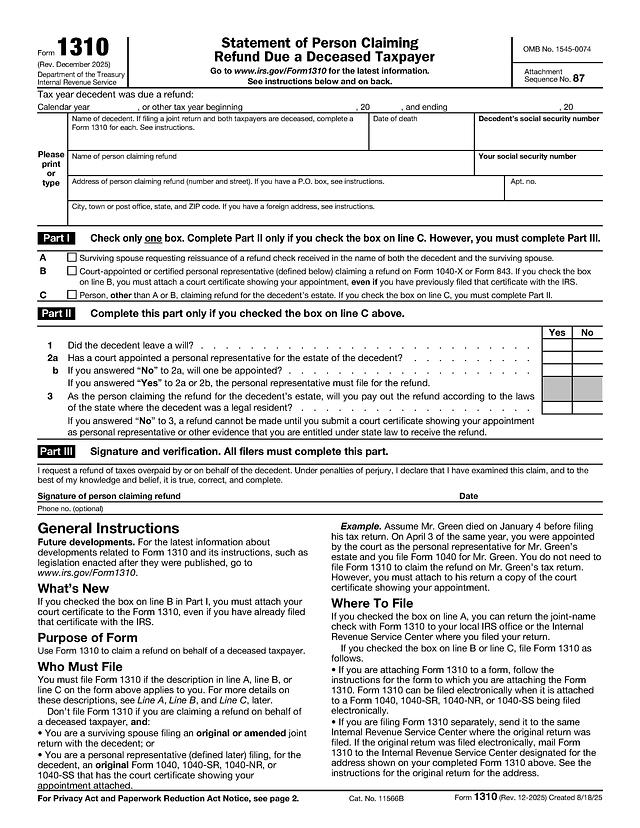
Form 1310 tells the IRS who should receive a federal tax refund when the person who was owed it has died. The IRS will not reissue or release a refund check made out to a deceased taxpayer without this statement, so it accompanies the decedent's final return, an amended return, or a refund claim filed after the original return.
The form has three parts. Part I asks you to check exactly one box describing your relationship to the decedent and the refund. Part II applies only if you checked box C, and it asks about a will and a court-appointed representative. Part III is the signature and declaration that every filer must complete.
Who typically needs it
- A surviving spouse who received a refund check issued jointly to both spouses and needs it reissued in their name alone (box A).
- A court-appointed or certified personal representative (executor or administrator) claiming a refund on an amended return (Form 1040-X) or a claim for refund (Form 843) (box B).
- Any other person, such as an adult child or other heir, claiming a refund for the decedent's estate when no court-appointed representative exists or will be appointed (box C).
You generally do not need Form 1310 if you are a surviving spouse filing an original or amended joint return with the decedent, or if you are a personal representative filing an original return with the court certificate of appointment already attached.
What you need before you start
- The decedent's full name, date of death and Social Security number.
- Your own name, Social Security number, and current mailing address.
- If you checked box B: a copy of the court certificate showing your appointment, even if you already sent it to the IRS before.
- If you checked box C: proof of death, such as a death certificate or official notification of death. You keep this for your records rather than attach it, and you provide it only if the IRS asks.
How to fill it out online with PDF Editify
Open the Form 1310 template, click Fill Template Now, and the form opens in the editor with every field ready to type into. Work through it in order:
- Tax year and decedent information: enter the calendar year or fiscal year the refund covers, then the decedent's name, date of death and Social Security number.
- Your information: your name, Social Security number, and mailing address, including an apartment number or a note about a foreign address if it applies.
- Part I: check the single box, A, B or C, that matches your situation.
- Part II (box C filers only): answer the three yes-or-no questions about a will and a court-appointed representative.
- Part III: type your signature, add the date, and optionally a phone number.
You can sign the PDF directly in the same session once the fields are complete, then download your filled copy.
Signing and where to submit
Every filer must sign Part III under penalty of perjury. Where the form goes depends on the box you checked:
| Box checked | Where to send it |
|---|---|
| A | Return the voided joint-name refund check together with Form 1310 to your local IRS office or the service center where the original return was filed. |
| B or C | If attaching Form 1310 to a return or claim, follow that form's filing instructions; it can be e-filed when attached to an electronically filed Form 1040, 1040-SR, 1040-NR or 1040-SS. If filing Form 1310 separately, mail it to the service center for the original return, or the center for your address if the original return was e-filed. |
The IRS keeps a form-specific page at irs.gov/Form1310 with the current version and any late updates.
Deadlines and fees
There is no fee to file Form 1310. It does not have its own due date, it follows the deadline of the return or claim it supports, most often the regular April 15 filing deadline or the October 15 extended deadline for the decedent's final return. A refund claim generally must be filed within the standard IRS refund statute of limitations, the later of three years from when the original return was due or two years from when the tax was paid; see IRS Publication 559, Survivors, Executors, and Administrators, for the rules that apply to a specific estate. Checked against the form revision dated December 2025 and the IRS Form 1310 page as of October 11, 2026.
Common mistakes
- Checking more than one box in Part I, or leaving Part I blank.
- Checking box C and skipping Part II, which the IRS requires for that box.
- Forgetting to attach the court certificate when box B is checked, even if the IRS already has a copy on file.
- Mailing the original death certificate instead of keeping it and providing it only if requested.
- Leaving Part III unsigned or undated, which delays processing of the refund.