What Form 8606 is
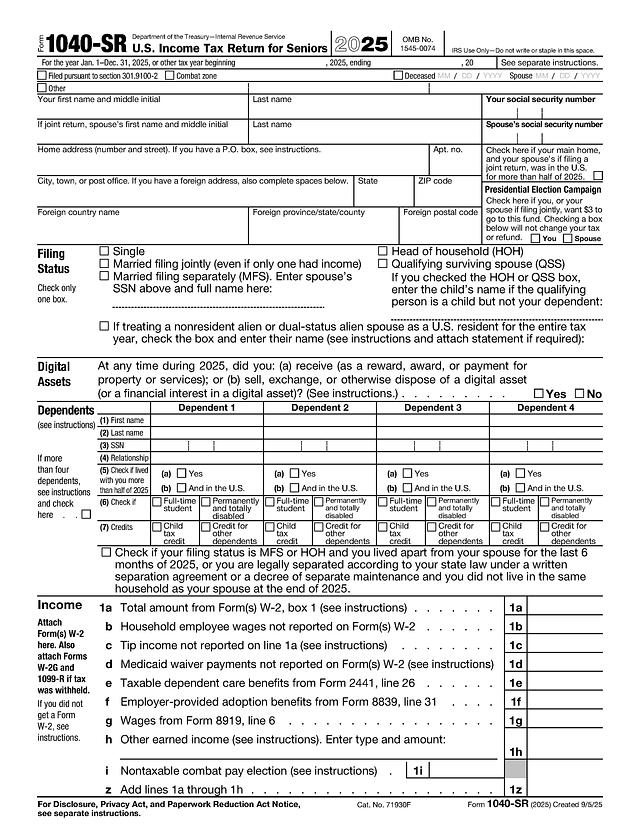
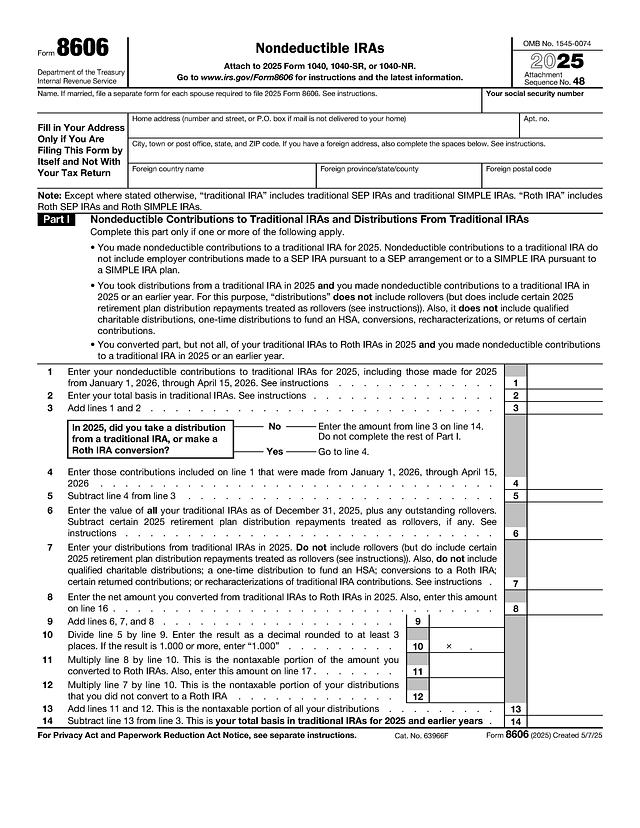
Form 8606, Nondeductible IRAs, is the IRS form for tracking the after-tax money (your "basis") in traditional IRAs and for figuring the taxable part of IRA distributions, Roth conversions and Roth IRA distributions. This template is the 2026 form, filed with a 2026 Form 1040, 1040-SR or 1040-NR. As of November 16, 2026, 2026 is the latest version posted on the IRS About Form 8606 page. If you are filing for 2025, for example a late or amended return, use the 2025 edition of the form instead.
The form notes that "traditional IRA" includes traditional SEP and SIMPLE IRAs but does not include Trump accounts, and "Roth IRA" includes Roth SEP and Roth SIMPLE IRAs.
Who files Form 8606
According to the Instructions for Form 8606, you file it if, for the tax year, you:
- made nondeductible contributions to a traditional IRA,
- took distributions from a traditional, SEP or SIMPLE IRA and have a basis from nondeductible contributions,
- converted traditional, SEP or SIMPLE IRA money to a Roth IRA, or
- took distributions from a Roth IRA (with some exceptions listed in the instructions).
The form says that if you are married, each spouse who must file one completes a separate Form 8606. Whether a contribution is deductible depends on your income and workplace plan coverage, which the instructions and IRS Publications 590-A and 590-B explain.
What to have ready
- The nondeductible contributions you made for 2026, including any made from January 1 through April 15, 2027
- Your total basis from earlier years, usually line 14 of your most recent Form 8606
- The value of all your traditional, SEP and SIMPLE IRAs on December 31, 2026, from your year-end statements
- Form 1099-R for any 2026 distributions and conversions
- For Roth distributions, your record of Roth contributions and earlier conversions
How to fill out Form 8606 online
Click "Fill Template Now", type your amounts into the lines, and download the finished PDF to attach to your paper return. If you are filing the form by itself, sign the PDF in the "Sign Here" block on page 2 first. Section by section:
Header and address
Enter your name and Social Security number. The home address lines are only for people filing Form 8606 by itself, not with a tax return. The 2026 form has separate spaces for city, state and ZIP code.
Part I: Nondeductible Contributions and Distributions From Traditional IRAs (lines 1 to 15c)
Line 1 is your 2026 nondeductible contributions and line 2 your total basis from earlier years; line 3 adds them. The form then asks whether you took a traditional IRA distribution or made a Roth conversion in 2026. If not, carry line 3 to line 14 and stop Part I. If yes, continue with line 4 (contributions made January 1 to April 15, 2027), line 6 (year-end value of all traditional IRAs plus outstanding rollovers), line 7 (2026 distributions, excluding rollovers, conversions and the other items the form lists) and line 8 (net amount converted to Roth IRAs). Line 10 is a ratio rounded to at least three decimal places, capped at 1.000. Lines 11 to 13 give the nontaxable portions, line 14 your remaining basis, and lines 15a to 15c the taxable amount, which also goes on Form 1040, line 4b.
Part II: 2026 Conversions From Traditional IRAs to Roth IRAs (lines 16 to 18)
Line 16 is the net amount converted, line 17 your basis in that amount, and line 18 the taxable amount, also included on Form 1040, line 4b.
Part III: Distributions From Roth IRAs (lines 19 to 25c)
Line 19 is your nonqualified Roth distributions and line 20 qualified first-time homebuyer expenses, which the form limits to $10,000 reduced by prior homebuyer distributions. Lines 22 and 24 are your basis in Roth contributions and in conversions and rollovers. Lines 25a to 25c give the taxable amount. Lines 15b and 25b are only for qualified disaster distributions reported on Form 8915-F.
Filing, deadlines and penalties
The instructions say to file Form 8606 with your return by its due date, including extensions. If you are not required to file a return, sign the form and send it to the IRS at the time and place you would otherwise file one. They also list a $50 penalty for not filing a required Form 8606 for a nondeductible contribution, and a $100 penalty for overstating nondeductible contributions, unless you can show reasonable cause. For the current contribution limit, see the Form 8606 instructions for 2026. The form itself notes a possible additional 10% tax on line 15c if you were under age 59½ at the time of the distribution. Source: IRS Form 8606 (2026), checked on November 16, 2026.
Common mistakes
- Not filing Form 8606 for a nondeductible contribution, which leaves no IRS record of your basis
- Entering only one account on line 6 instead of all traditional, SEP and SIMPLE IRAs
- Including rollovers or conversions on line 7
- Rounding line 10 to fewer than three decimal places
- Filing one combined form for both spouses
The form attaches to your Form 1040. More forms are in our IRS tax form templates.