What Form 8863 is
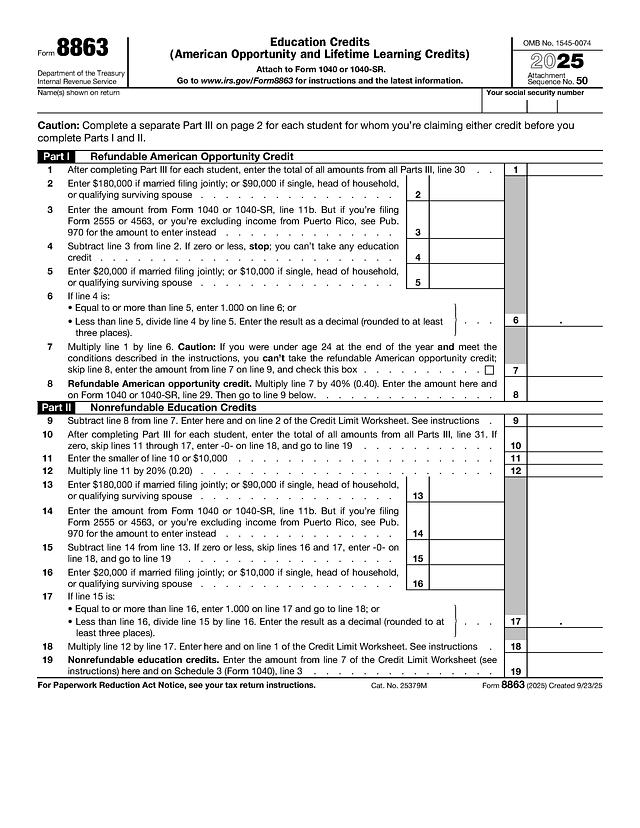
Form 8863, Education Credits (American Opportunity and Lifetime Learning Credits), is the IRS form that attaches to Form 1040 or 1040-SR when you claim an education credit for tuition and related costs. The 2025 edition has two pages. Page 1 holds Part I (the refundable American opportunity credit) and Part II (the nonrefundable education credits). Page 2 holds Part III, which collects information about each student and the school.
Who typically needs it
Taxpayers who paid qualified education expenses for themselves, a spouse or a dependent and want to claim the American opportunity credit or the lifetime learning credit use this form. The form warns that you cannot take both credits for the same student in the same year. Whether a student, school or expense qualifies is a decision for the IRS instructions and Publication 970, not for this page.
What you need before you start
- Your name and Social security number as shown on your return.
- For each student: name and Social security number as shown on your return.
- For each school: name, address and employer identification number (EIN). The EIN is printed on Form 1098-T or can be obtained from the school.
- Form 1098-T from each school, and your records of tuition and related expenses.
- The amount from Form 1040 or 1040-SR, line 11b, for lines 3 and 14.
- The Credit Limit Worksheet from the instructions, which is needed for lines 9, 18 and 19.
Open the Instructions for Form 8863 alongside the form.
How to fill it out online with PDF Editify
Click "Fill Template Now" on this page. The form opens in the editor with its 77 text and checkbox fields ready. Click a field, type the value, and tick the Yes and No boxes where the form asks. The form tells you to complete Part III for each student before Parts I and II, so start on page 2.
Part III: student and school information (page 2)
- Lines 20 and 21: student name and Social security number.
- Line 22a and 22b: the first and second educational institution, each with address, two Yes/No questions about Form 1098-T (for 2025, and for 2024 with box 7 checked), and the EIN in item (4).
- Lines 23 to 26: Yes/No questions about prior years of the American opportunity credit, half-time enrollment, completion of the first four years of postsecondary education and drug felony convictions. Each answer tells you where to go next, either to lines 27 to 30 or straight to line 31.
- Lines 27 to 30: American opportunity credit amounts, starting with adjusted qualified education expenses, which the form says not to enter above $4,000.
- Line 31: adjusted qualified education expenses for the lifetime learning credit. Do not complete line 31 if you completed lines 27 to 30 for that student.
Use additional copies of page 2 for further students.
Part I: refundable American opportunity credit (page 1)
Line 1 is the total of all line 30 amounts from Part III. Lines 2 to 6 compare your income with the thresholds printed on the form ($180,000 if married filing jointly, $90,000 for other filing statuses, with phase-out ranges of $20,000 and $10,000). Line 6 is a decimal rounded to at least three places. Line 7 has a check box for filers under age 24 who meet the conditions in the instructions. Line 8 is 40% of line 7 and goes to Form 1040 or 1040-SR, line 29.
Part II: nonrefundable education credits
Line 9 is line 7 minus line 8. Line 10 totals the line 31 amounts. Lines 11 to 18 apply the 20% rate and the same income comparison again. Line 19 takes its value from line 7 of the Credit Limit Worksheet and goes to Schedule 3 (Form 1040), line 3.
Signing, and where and how to submit
Form 8863 has no signature line. You sign the Form 1040 it is attached to. File it with your return, electronically or on paper, as described in the Form 1040 instructions. The official page is irs.gov/forms-pubs/about-form-8863. To add your signature to other documents, see how to sign a PDF.
Deadlines and fees
The IRS charges no fee for the form. It is due with your Form 1040. Returns for tax year 2025 were due April 15, 2026, or October 15, 2026 with an extension. For later years, check the Form 1040 instructions. Source: IRS, as of November 3, 2026.
Common mistakes
- Completing Parts I and II before Part III, instead of finishing Part III for each student first.
- Entering amounts for both credits for the same student.
- Leaving out the school's EIN when the form asks for it.
- Entering more than $4,000 on line 27.
- Using a Social security number or name that does not match the return.
- Skipping the Credit Limit Worksheet before line 19.