What Schedule C is
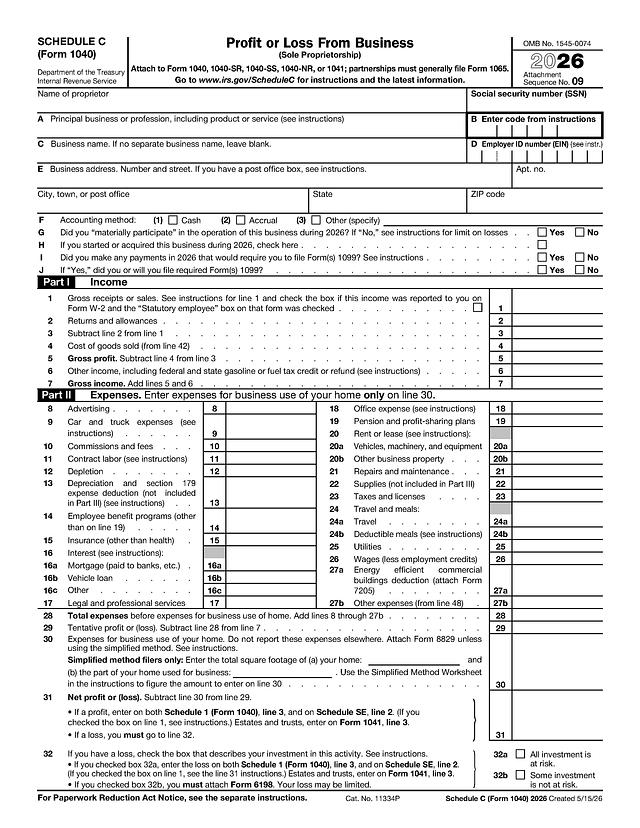
Schedule C (Form 1040), "Profit or Loss From Business (Sole Proprietorship)", is the IRS form where a sole proprietor adds up business income and expenses for the year. The net profit or loss from line 31 flows to your Form 1040 through Schedule 1 and, for a profit, to Schedule SE for self-employment tax. This page offers the 2026 version of the form, which covers income earned in calendar year 2026.
Who typically needs it
Schedule C is filed by people who run a business on their own, without a separate corporation or partnership return. Typical filers are freelancers, contractors, gig workers, online sellers and owners of a single-member LLC taxed as a sole proprietorship. The form header states that partnerships must generally file Form 1065 instead. The IRS page for Schedule C explains who must file, and your tax professional can answer questions about your own situation.
What you need before you start
- Your name as shown on your return and your Social Security number (SSN).
- Your employer ID number (EIN), if you have one.
- A description of your main business activity and the business code from the instructions.
- Totals of gross receipts, returns and allowances, and each expense category for 2026, from your bookkeeping, bank statements and any Forms 1099-NEC, 1099-K or 1099-MISC you received.
- Vehicle details and inventory figures, if they apply to you.
- The official Schedule C instructions open in another tab.
How to fill it out online with PDF Editify
- Click "Fill Template Now" on this page. The form opens in the editor with its fields ready to type into.
- Click a field and type. Checkboxes are ticked with a single click.
- Sign any related documents with the sign PDF tool (draw, type or upload a signature).
- Download the finished PDF. Downloading needs a plan: the One Week Plan costs $3 one-time and expires on its own, Standard is $10 per month or $100 per year, and Lifetime starts at $99 one-time.
Header and lines A to J
Enter the proprietor's name and SSN at the top. Line A is the principal business or profession, including the product or service, and line B is the code from the instructions. Line C is the business name (leave it blank if you have none) and line D the EIN. Line E is the business address. On line F choose the accounting method: cash, accrual or other. Line G asks whether you materially participated in the business during 2026, and line H is ticked only if you started or acquired the business this year. Lines I and J ask whether you made payments that required Forms 1099, and whether you filed or will file them.
Part I: Income (lines 1 to 7)
Line 1 is gross receipts or sales. Tick the box on line 1 only if the income was reported on a Form W-2 with the "Statutory employee" box checked. Line 2 is returns and allowances, line 3 is line 1 minus line 2, and line 4 is cost of goods sold from line 42. Line 5 is gross profit, line 6 is other income, and line 7 is gross income.
Part II: Expenses (lines 8 to 31)
Lines 8 to 27b list expense categories such as advertising, car and truck expenses, commissions, contract labor, insurance, interest, legal and professional services, office expense, rent, repairs, supplies, taxes and licenses, travel, deductible meals, utilities and wages. Read the instructions for lines with limits, such as car and truck expenses and meals. Line 28 totals lines 8 through 27b, and line 29 is the tentative profit or loss. Line 30 is for the business use of your home: attach Form 8829 or use the simplified method and enter the square footage. Line 31 is the net profit or loss. If it is a loss, use line 32 to tick whether all or only some of your investment is at risk.
Part III: Cost of goods sold (lines 33 to 42)
Complete this part only if you hold inventory. Pick the valuation method on line 33, answer line 34, then enter inventory, purchases, labor, materials and other costs. Line 42 carries to line 4.
Parts IV and V: Vehicle and other expenses
Part IV (lines 43 to 47) asks when the vehicle went into service, the business, commuting and other miles, and whether you have evidence. Fill it in only if you claim car and truck expenses and are not required to file Form 4562. Part V, line 48, is the total of other expenses that fit no listed category.
Signing, and where and how to submit
Schedule C has no signature line of its own. It is attached to your Form 1040, 1040-SR, 1040-SS, 1040-NR or 1041, and the signature goes on that return. If you file on paper, print this schedule and attach it behind your Form 1040. Submission methods and mailing addresses are on the IRS page for your return. If you e-file, your tax software generates its own Schedule C, so keep this copy for your records.
Deadlines and fees
Schedule C is filed together with your income tax return, and the usual due date is April 15 after the tax year ends. There is no filing fee for the form itself. Self-employed people often make quarterly payments, which our Form 1040-ES guide covers. As of November 1, 2026, the IRS "When to file" page (irs.gov/filing/individuals/when-to-file) lists April 15 as the standard deadline for individual returns. Confirm the exact date for your return year there.
Common mistakes
- Entering personal expenses or business-use-of-home costs on lines 8 to 27 instead of line 30.
- Skipping Part III or Part IV details when they apply, or leaving line 4 without a figure.
- Reporting the same income twice, for example from a Form 1099-K and a Form 1099-NEC for the same sales.
- Using the wrong year. This is the 2026 form.
- Forgetting to attach Schedule SE, Schedule 1 or Form 8829 when the instructions call for them.