What Schedule D is
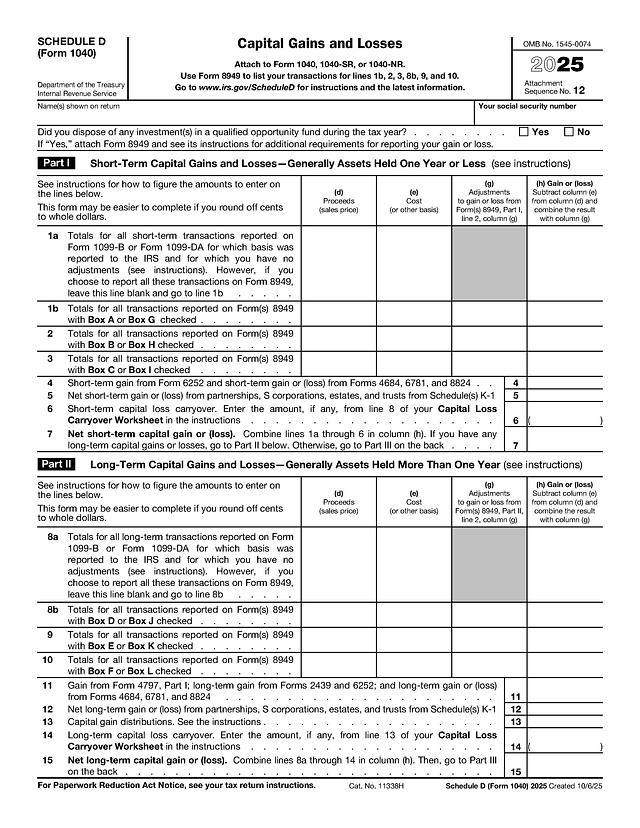
Schedule D (Form 1040), "Capital Gains and Losses", is the summary page for selling investments. Individual transactions are listed on Form 8949, and Schedule D adds them up, separates short-term results from long-term ones, and produces the net figure that moves to your Form 1040. The version on this page is the 2025 form, as printed in the header, with the footer note "Created 10/6/25".
Who typically needs it
People who sold stocks, bonds, mutual fund shares, digital assets or other capital assets during the tax year usually attach Schedule D to their Form 1040, 1040-SR or 1040-NR. It is also used to carry in capital gain distributions, gains from partnerships and S corporations reported on Schedule K-1, and loss carryovers from earlier years. The IRS page for Schedule D and the official instructions explain who must file. If you are unsure about your own case, a tax professional can answer it.
What you need before you start
- Your name as shown on your return and your Social Security number.
- Completed Form 8949 totals, if you report transactions there. See our guide on how to fill out Form 8949.
- Forms 1099-B or 1099-DA from your broker or exchange, with proceeds and cost basis.
- Any Schedule K-1 amounts and capital gain distributions from Form 1099-DIV.
- Your Capital Loss Carryover Worksheet from the prior year, if you had a net loss then.
How to fill it out online with PDF Editify
- Click "Fill Template Now" on this page. Schedule D opens in the editor with its fields ready to type into.
- Click a field and type. Checkboxes are ticked with one click.
- Use the sign PDF tool if you need to add a signature to related paperwork. You can draw, type or upload a signature.
- Download the finished PDF. Downloading needs a plan: the One Week Plan costs $3 one-time and expires on its own, Standard is $10 per month or $100 per year, and Lifetime starts at $99 one-time.
Header and the qualified opportunity fund question
Enter your name and Social Security number at the top of page 1. Then answer the Yes or No question about disposing of any investment in a qualified opportunity fund during the year. If you answer Yes, the form tells you to attach Form 8949 and read its instructions for extra requirements.
Part I: short-term gains and losses
Part I covers assets held one year or less. Each row has columns for proceeds (d), cost or other basis (e), adjustments (g) and gain or loss (h). Line 1a is for totals from Form 1099-B or 1099-DA where basis was reported to the IRS and you have no adjustments. Lines 1b, 2 and 3 take the totals from Form 8949 for the boxes named on each line. Line 4 takes short-term gains from Forms 6252, 4684, 6781 and 8824, line 5 takes short-term results from Schedule K-1, and line 6 is the short-term carryover, entered in parentheses as a loss. Line 7 combines lines 1a through 6 in column (h).
Part II: long-term gains and losses
Part II mirrors Part I for assets held more than one year. Lines 8a, 8b, 9 and 10 are the long-term totals, line 11 takes gains from Form 4797 and similar forms, line 12 takes Schedule K-1 results, line 13 is capital gain distributions, and line 14 is the long-term carryover. Line 15 is the net long-term gain or loss.
Part III: summary on page 2
Line 16 combines lines 7 and 15. A gain moves to Form 1040 line 7a, and the form then asks whether lines 15 and 16 are both gains (line 17). Lines 18 and 19 apply only if the 28% Rate Gain Worksheet or the Unrecaptured Section 1250 Gain Worksheet is required. Line 20 decides whether you use the Qualified Dividends and Capital Gain Tax Worksheet or the Schedule D Tax Worksheet. If line 16 is a loss, line 21 limits the amount carried to Form 1040 to the smaller of the loss or $3,000 ($1,500 if married filing separately). Line 22 asks about qualified dividends on Form 1040 line 3a.
Signing, and where and how to submit
Schedule D has no signature line of its own. It is filed as an attachment to your Form 1040, 1040-SR or 1040-NR, so the signature goes on the main return. Send it with the return the way you file the rest of it, either by e-file or by mail. The IRS lists filing options and addresses on its filing page, and the instructions for your return name the mailing address for your state.
Deadlines and fees
There is no IRS fee to file Schedule D. It is due with your tax return. The IRS lists April 15 as the usual due date for individual returns, moved to the next business day when it falls on a weekend or holiday, and an extension to file is available through Form 4868 (source: IRS filing and extension pages, checked 2026-11-08). The 2025 version on this page applies to income earned in calendar year 2025, which is also the version to use for a late return for that year.
Common mistakes
- Entering individual transactions on Schedule D that belong on Form 8949, unless the instructions allow totals on lines 1a or 8a.
- Forgetting to enter loss carryovers on lines 6 and 14 in parentheses, or leaving out the worksheet that supports them.
- Carrying a loss larger than the $3,000 limit ($1,500 if married filing separately) to Form 1040 line 7a.
- Mixing up short-term and long-term holding periods, which changes which part the sale belongs in.
- Skipping the 28% Rate Gain or Unrecaptured Section 1250 Gain worksheets when the instructions require them.
- Forgetting to use the Qualified Dividends and Capital Gain Tax Worksheet or the Schedule D Tax Worksheet that line 20 points to.