What this South Dakota rental application is
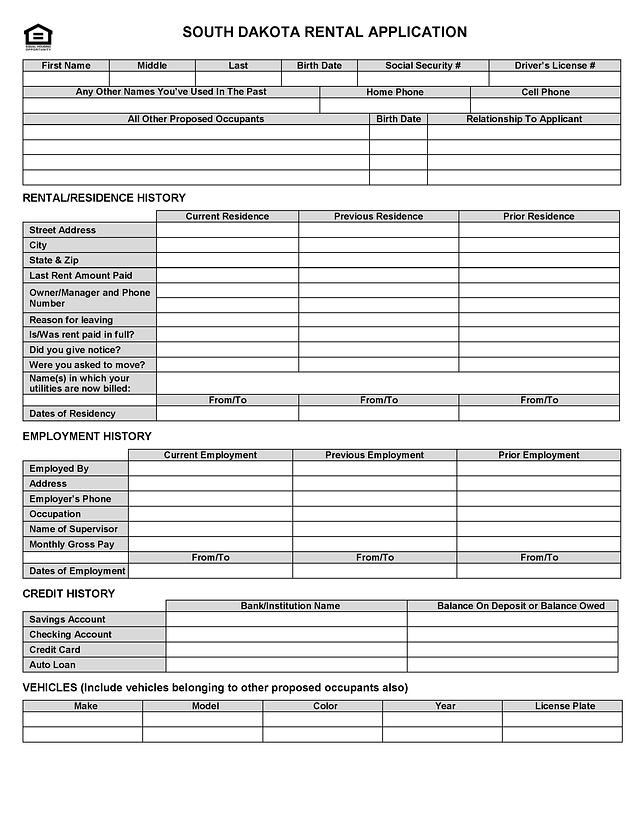
This is a two-page South Dakota Rental Application template for apartments and houses. It is a general screening form used by landlords and property managers, not a form issued by any South Dakota agency. It collects identity details, three residences, three jobs, credit accounts, vehicles and references, asks a set of general screening questions, and ends with a signed authorization for credit and criminal checks.
Who uses it
South Dakota renters applying to private landlords, and landlords who want a ready-made application. Each adult applicant usually completes a separate copy.
What to have ready
- Your Social Security number, birth date and driver's license number.
- Addresses, last rent paid, dates and landlord contacts for up to three residences.
- Employer names, addresses, phone numbers, supervisors, monthly gross pay and dates for up to three jobs.
- Bank, credit card and auto loan institutions with balances.
- Vehicle details for everyone who will live in the unit, and pet type, breed, weight and age.
Our guide to documents needed for a rental application has more detail.
How to fill it out online
Click "Fill Template Now," type your answers into each row, sign, and download the completed PDF to send to the landlord.
Page 1, top: you and your household
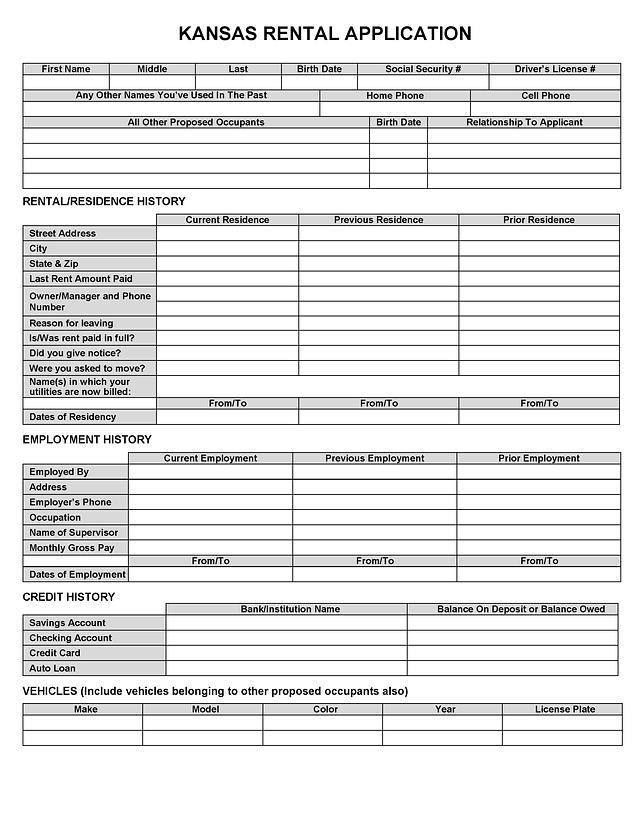
Type your legal first, middle and last name, then birth date, Social Security number, driver's license number, home and cell phones, and any former names (for example a maiden name). The four occupant rows take each additional person's name, birth date and relationship to you.
Page 1: Rental/Residence History
The grid has columns for your current, previous and prior home. For each, the rows ask for street address, city, state and ZIP, the last rent you paid, the owner or manager with a phone number, why you left, and three yes or no style rows: rent paid in full, notice given, and asked to move. Finish with the dates you lived at each place and the name on your current utility accounts.
Page 1: Employment History, Credit History and Vehicles
The employment grid mirrors the residence grid: employer, address, phone, occupation, supervisor, monthly gross pay and dates, for up to three jobs. Credit History has four rows (savings, checking, credit card, auto loan) where you name the institution and the balance held or owed. The vehicle table has room for two cars, and the form asks you to include cars owned by anyone else moving in.
Page 2: References and Emergency Contacts
Three columns ask for a doctor, a lawyer and a relative who lives elsewhere, each with address and phone. The printed paragraph gives the landlord permission to contact them if you cannot be reached, and lets that relative remove your belongings if the unit is abandoned. If you have no lawyer or prefer not to list a doctor, ask the landlord whether those columns are required.
Page 2: General Information
Each question gets its own answer line. They cover late rent and eviction notices, bankruptcy, felony convictions, smokers in the household, pets, problems with your current landlord, reasons for moving, your move-in date and expected length of stay, optional income you want counted, a person who could lend you rent, past lawsuits, anything a background check may reveal, how you found the listing, your email, and friends who are also looking.
Agreement and Authorization
Your signature confirms your answers and authorizes credit and criminal checks and calls to the people you listed. The text also says the application is not a lease and that a non-refundable fee covers processing. You can sign the PDF online and then download it.
South Dakota rules worth knowing
General information as of October 2026, from South Dakota Codified Laws chapter 43-32 (Lease of Real Property):
- Application fees: chapter 43-32 does not regulate or cap rental application or screening fees. Ask the landlord the amount and whether it is refundable before you apply, and get a receipt.
- Security deposits: under SDCL 43-32-6.1, a landlord may not demand or receive a deposit greater than one month's rent, unless the landlord and tenant agree to a larger deposit because special conditions pose a danger to maintenance of the premises.
- Return deadline: SDCL 43-32-24, as amended in 2026, requires the landlord to return the deposit or give a written statement of the specific reasons for withholding it within 21 days after the tenancy ends and the landlord receives the tenant's mailing address or delivery instructions. The earlier law allowed two weeks, so older guides may show that period. Within 45 days after the tenancy ends, on the tenant's request, the landlord must give an itemized accounting of any amount withheld. Bad faith retention can lead to punitive damages of up to $200.
For advice about your situation, contact a qualified attorney or legal aid office.
Common mistakes
- Leaving "Is/Was rent paid in full?" or "Were you asked to move?" blank for past residences.
- Forgetting to give your landlord a forwarding mailing address when you move out later, which affects when the deposit deadline starts.
- Omitting vehicles that belong to other occupants.
- Answering the optional income question with amounts you cannot verify.