What Form N-400 is
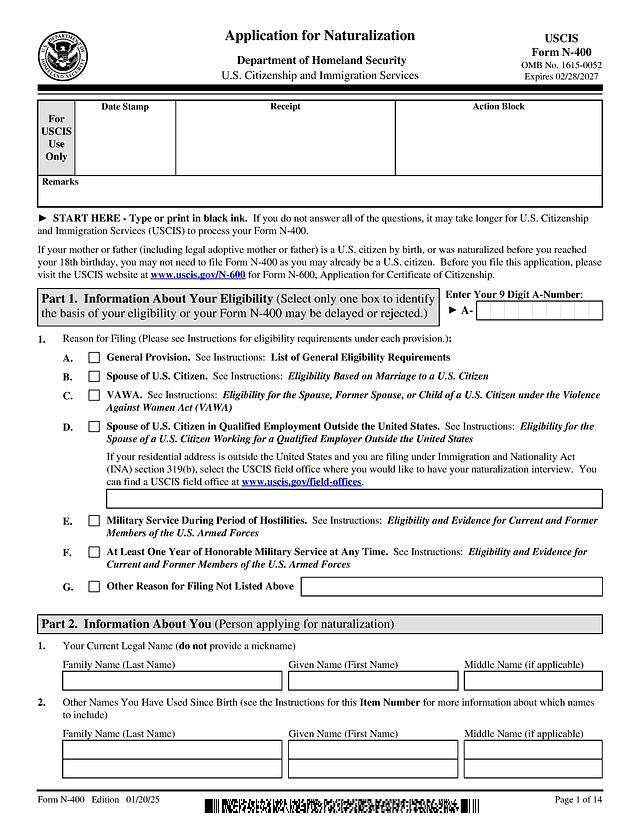
Form N-400, Application for Naturalization, is the U.S. Citizenship and Immigration Services (USCIS) form lawful permanent residents use to apply for U.S. citizenship. This template is the 14-page edition 01/20/25, the edition shown on the official USCIS Form N-400 page as of October 3, 2026. If you print and mail the form, USCIS asks that the edition date and page numbers be visible at the bottom of every page and that all pages come from the same edition.
You can open the form here, type your answers, and download a filled-in PDF to print. The blank form and its instructions are also available as PDFs on the USCIS N-400 page. USCIS publishes a Spanish-language version of that page at uscis.gov/es/n-400. The template here is the English form.
Who typically files it
Part 1 asks you to pick one basis for eligibility. On this edition the options are the general provision, spouse of a U.S. citizen, VAWA, spouse of a U.S. citizen in qualified employment outside the United States, two military service options, and "other reason for filing not listed above." Whether you meet the residence, physical presence, and other requirements is covered in the Form N-400 instructions. For questions about your own eligibility, consult a qualified immigration attorney or accredited representative.
As of October 3, 2026, the USCIS N-400 page states that you may file up to 90 calendar days before you complete the continuous residence requirement, if you qualify under the 5-year or 3-year rule.
What to have ready
- Your Green Card, A-Number, and USCIS Online Account Number if you have one
- Every address where you lived during the last 5 years (or the period that applies to you)
- Employment and school history for the same period
- Dates of every trip outside the United States lasting more than 24 hours
- Marital history, your spouse's details, and information about each of your children
- Records related to any arrests, citations, or court matters, if applicable
How to fill out Form N-400 online with PDF Editify
Click "Fill Template Now," type into the fields, and download the finished PDF to print. Do not add an electronic signature. The signature must be handwritten on the printed form.
Parts 1 to 4: eligibility, personal and residence details
Part 1 is your eligibility basis and A-Number. Part 2 covers your legal name, other names used, whether you want to legally change your name, sex, date of birth, the date you became a permanent resident, country of birth and citizenship, the disability question (which refers to Form N-648), and the Social Security card update question. Part 3 is biographic information. Part 4 lists your residences, starting with the current one.
Parts 5 to 8: family, work, and travel
Part 5 is your marital history, Part 6 is information about your children, Part 7 is your employment and schools attended, and Part 8 lists trips outside the United States. Start with the most recent trip and work backward, and leave out day trips completed within 24 hours.
Part 9: Additional Information About You
A long series of yes or no questions. Answer every one, and explain any "Yes" in Part 14 where the form asks you to.
Parts 10 to 16
Part 10 is the request for a fee reduction, based on household income. Part 11 is your contact information, certification, and signature. Parts 12 and 13 are for an interpreter or preparer, and Part 14 is extra space. Leave Parts 15 and 16 blank. The form says not to complete them until a USCIS officer tells you to at the interview.
Signing and filing
Under the USCIS Policy Manual signature rules, a paper application needs an original handwritten signature. Typed names, software-generated signatures, and signature images pasted onto the form are not valid. Sign Part 11 in ink after printing.
USCIS also accepts Form N-400 online through a USCIS online account, where you sign electronically. For paper filings, the "Where to File" section of the N-400 page gives the mailing address that applies to you.
Fees
The filing fee differs for online and paper filing, and a reduced fee may apply based on income. Check the current amounts in the USCIS Fee Schedule (Form G-1055) before paying, since fees change.
Common mistakes
- Filing more than 90 days before the continuous residence requirement is met
- Selecting more than one eligibility basis in Part 1
- Leaving gaps in the address, employment, or travel history
- Skipping questions in Part 9 or not explaining a "Yes" answer
- Filling in Parts 15 or 16 before the interview
- Typing the signature, or mixing pages from different editions
Read our N-400 how-to guide for more detail, or browse other U.S. government forms.