What Form 8995 is
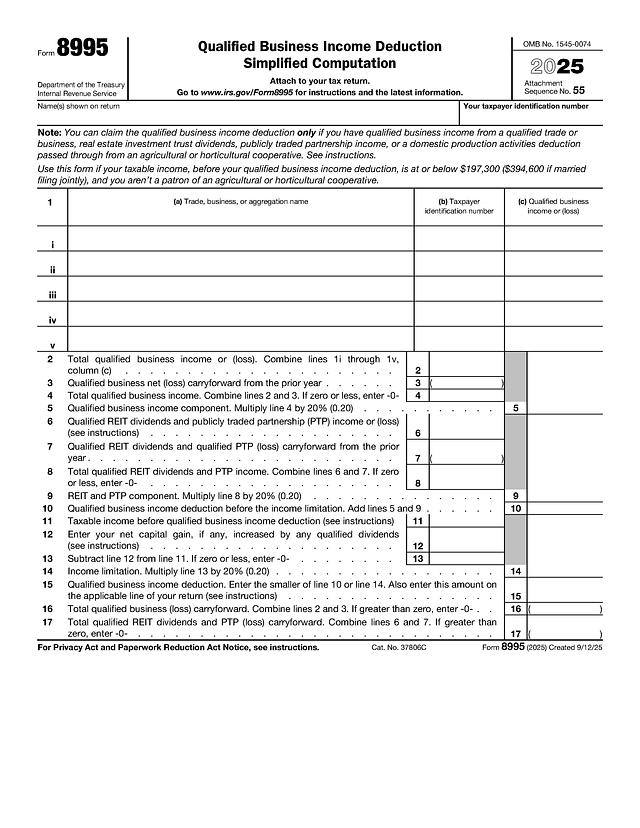
Form 8995 is the Qualified Business Income Deduction Simplified Computation, published by the Internal Revenue Service. It calculates the qualified business income (QBI) deduction, which lets eligible taxpayers deduct up to 20% of qualified income from a pass-through business, plus 20% of qualified REIT dividends and publicly traded partnership (PTP) income. The result is carried to your Form 1040. This is the short version of the calculation. The longer Form 8995-A exists for higher incomes and certain cooperative patrons.
Who typically needs it
The form is used by sole proprietors, freelancers, partners, S corporation shareholders and landlords whose business income passes through to a personal return, as well as people who receive REIT dividends or PTP income. According to the form header, the simplified version is for taxpayers whose taxable income before the QBI deduction is at or below $197,300 ($394,600 if married filing jointly) and who are not patrons of an agricultural or horticultural cooperative. If you are above those figures, the IRS instructions point you to Form 8995-A. Whether a particular activity counts as a qualified trade or business is a question for the official instructions or a tax professional.
What you need before you start
- Your name and taxpayer identification number as shown on your return.
- The name, taxpayer identification number and qualified business income or loss for each business, for example the net profit from Schedule C, Schedule E or a Schedule K-1.
- Any qualified business loss carryforward and REIT/PTP loss carryforward from last year's Form 8995 (lines 16 and 17).
- Your taxable income before the QBI deduction, which comes from your draft Form 1040.
- Your net capital gain plus qualified dividends, if any.
How to fill out Form 8995 online with PDF Editify
- Open this page and click "Fill Template Now". The form opens in the editor with its fields ready.
- Click each field and type your entry. Use the Tab key to move to the next one.
- Check the totals you typed against your own worksheet, since you enter the results yourself.
- Sign if your filing method requires it, then download the finished PDF (a plan is needed to download).
Header
Enter your name(s) as shown on your return and your taxpayer identification number.
Line 1: your businesses
The form has five rows, labelled i to v. For each business enter (a) the trade, business or aggregation name, (b) its taxpayer identification number, and (c) the qualified business income or loss. Enter losses as negative numbers. Line 2 is the combined total of column (c).
Lines 3 to 5: the business income component
Line 3 is the qualified business net loss carried from the prior year, entered in parentheses. Line 4 combines lines 2 and 3, and if the result is zero or less you enter -0-. Line 5 multiplies line 4 by 20%.
Lines 6 to 9: REIT and PTP income
Line 6 holds qualified REIT dividends and PTP income or loss. Line 7 is the prior year loss carryforward. Line 8 combines them (or -0-), and line 9 multiplies by 20%.
Lines 10 to 15: the deduction and income limit
Line 10 adds lines 5 and 9. Line 11 is your taxable income before the QBI deduction, and line 12 is net capital gain plus qualified dividends. Line 13 subtracts line 12 from line 11, and line 14 multiplies that by 20%. Line 15 is the smaller of line 10 or line 14. Enter that amount on the line of your return named in the instructions.
Lines 16 and 17: carryforwards
These record any loss to carry into next year. If the combined amount is greater than zero, enter -0-. Keep these figures, because you will need them for next year's form.
Signing, and where and how to submit
Form 8995 has no signature block of its own, because it is an attachment. It goes with your Form 1040 and is signed through that return. If you file electronically, your tax software generates the form, and a PDF copy is useful for your records or for a paper filing. For a paper return, attach the form behind your Form 1040 and mail the package to the address in the Form 1040 instructions for your state. If you need a signature on a related document, you can sign a PDF by drawing, typing or uploading a signature. The official form page is irs.gov/forms-pubs/about-form-8995.
Deadlines and fees
There is no fee to file the form, and it has no separate due date. It is due with your income tax return. For the 2025 tax year the standard due date for individual returns is April 15, 2026, and extensions apply to the return as a whole (source: IRS, checked November 13, 2026). Our pricing page lists the plan options for downloading a filled PDF.
Common mistakes
- Using the wrong form. If your taxable income is above the threshold printed on the form, the IRS directs you to Form 8995-A.
- Entering losses as positives. Losses in column (c) and carryforwards on lines 3, 7, 16 and 17 are negative numbers, shown in parentheses on the form.
- Skipping the carryforward. Last year's lines 16 and 17 become this year's lines 3 and 7.
- Mismatched taxable income. Line 11 must come from your return before the QBI deduction. Changing your return later means redoing lines 11 to 15.
- Forgetting the TIN for each business. Column (b) needs a taxpayer identification number for every row.
- Copying the result to the wrong line. Use the line on your return named in the instructions for line 15.