Form W-9 - Request for Taxpayer Identification Number
Used by businesses to collect taxpayer identification information from vendors, contractors, and other payees. Required for reporting payments to the IRS on forms like 1099-MISC.

Vervollständigen Sie Ihre Form W-9 - Request for Taxpayer Identification Number in 3 einfachen Schritten
Vorlage ausfüllen und bearbeiten
Online unterschreiben
Sofort exportieren oder drucken
What Form W-9 is
Form W-9, Request for Taxpayer Identification Number and Certification, is how a U.S. person gives their correct taxpayer identification number (TIN) to someone who must file an information return about payments made to them. This template is the IRS Rev. March 2024 edition, which is still the version posted on IRS.gov as of October 2026. The W-9 is not revised every year, so a 2024 date does not mean it is out of date. The PDF has six pages: the form on page 1 and the instructions on pages 2 to 6.
Who uses it
Freelancers, independent contractors, landlords, vendors, and other payees complete a W-9 when a business, bank, or client asks for it. The requester uses your name and TIN to prepare forms such as 1099-NEC, 1099-MISC, or 1099-INT. Businesses also collect W-9s from LLCs, partnerships, and corporations. Foreign persons do not use this form; the instructions direct them to the appropriate Form W-8.
What to have ready
- Your legal name as shown on your tax return, and any business or disregarded entity name
- Your federal tax classification (and for an LLC, how it is taxed)
- Your social security number or employer identification number
- Your mailing address
- Any exemption codes, if you are an entity that qualifies (individuals generally don't)
How to fill it out online
Click "Fill Template Now," type into the fields on page 1, sign the certification, and download the PDF to send to the person who requested it. The fields follow the numbered lines on the form.
Lines 1 and 2: names
Line 1, the name of the entity or individual, is required. A sole proprietor or disregarded entity enters the owner's name on line 1 and the business or disregarded entity name on line 2.
Line 3a and 3b: tax classification
Check only one of the seven boxes on line 3a: Individual/sole proprietor, C corporation, S corporation, Partnership, Trust/estate, LLC, or Other. If you check LLC, enter C, S, or P for how the LLC is taxed. An LLC that is a disregarded entity checks the box for its owner's classification instead. Line 3b, added in the 2024 revision, applies only to partnerships, trusts, estates, and LLCs taxed as partnerships that are giving the form to a flow-through entity in which they hold an interest; it asks whether there are any foreign partners, owners, or beneficiaries.
Line 4: exemptions
Enter an exempt payee code and a FATCA exemption code only if they apply. The codes are listed in the instructions on page 3 and apply to certain entities, not individuals.
Lines 5 to 7
Enter your street address on line 5 and city, state, and ZIP code on line 6. Line 7 is an optional place to list account numbers. The requester's name and address box is also optional.
Part I: Taxpayer Identification Number
Enter either a social security number or an employer identification number in the matching boxes. The TIN must match the name on line 1 to avoid backup withholding. Individuals generally use their SSN; sole proprietors and disregarded entities should follow the Part I instructions on which number to give.
Part II: Certification
By signing, you certify under penalties of perjury the four statements on the form, including that your TIN is correct and that you are a U.S. person. If the IRS has notified you that you are currently subject to backup withholding for underreporting interest or dividends, the form instructs you to cross out item 2. Then sign and date. You can add your signature with our online PDF signer.
Where it goes
Give the completed W-9 to the person or business that requested it. The form itself says "Do not send to the IRS." The requester keeps it on file. Because the form contains your SSN or EIN, send it through a secure channel your requester provides rather than ordinary email when possible.
The W-9 has no filing deadline of its own; provide it when the requester asks, usually before the first payment. If you don't provide a correct TIN, the payer may be required to apply backup withholding. For questions about your classification or exemptions, see the official Instructions for the Requester of Form W-9 or a tax professional.
Common mistakes
- Putting a business trade name on line 1 instead of the owner's name for a sole proprietorship or disregarded entity
- Checking more than one box on line 3a, or checking LLC without entering C, S, or P
- Entering a TIN that doesn't match the line 1 name
- Forgetting to sign and date Part II
- Mailing the form to the IRS instead of returning it to the requester
Freelancers can find more examples in our W-9 guide for freelancers.
Offizielle Quelle: Internal Revenue Service · Version: Rev. March 2024
Formulare, Fristen und Gebühren ändern sich. Prüfen Sie vor dem Einreichen auf der offiziellen Website, ob Sie die aktuelle Version verwenden. Diese Seite ist keine Rechts- oder Steuerberatung.
Häufig gestellte Fragen
Is the March 2024 Form W-9 the latest version?
Yes. As of October 2026, Rev. March 2024 is the edition posted on IRS.gov. The W-9 is revised only when needed, not every year.
Who should I send my completed W-9 to?
Return it to the business or person who requested it. The form says not to send it to the IRS.
Do I need to sign Form W-9?
Generally yes, you sign the Part II certification. The form notes some payment types where signing the certification is not required, but you must still provide your correct TIN.
Should I use my SSN or EIN on Form W-9?
Individuals generally use their SSN, and most entities use their EIN. Sole proprietors and disregarded entities should follow the Part I instructions on the form.
What is line 3b on the new W-9?
Line 3b was added in the 2024 revision for partnerships, trusts, estates, and LLCs taxed as partnerships that give the form to a flow-through entity, to report whether they have foreign partners, owners, or beneficiaries.
Verwandte Vorlagen
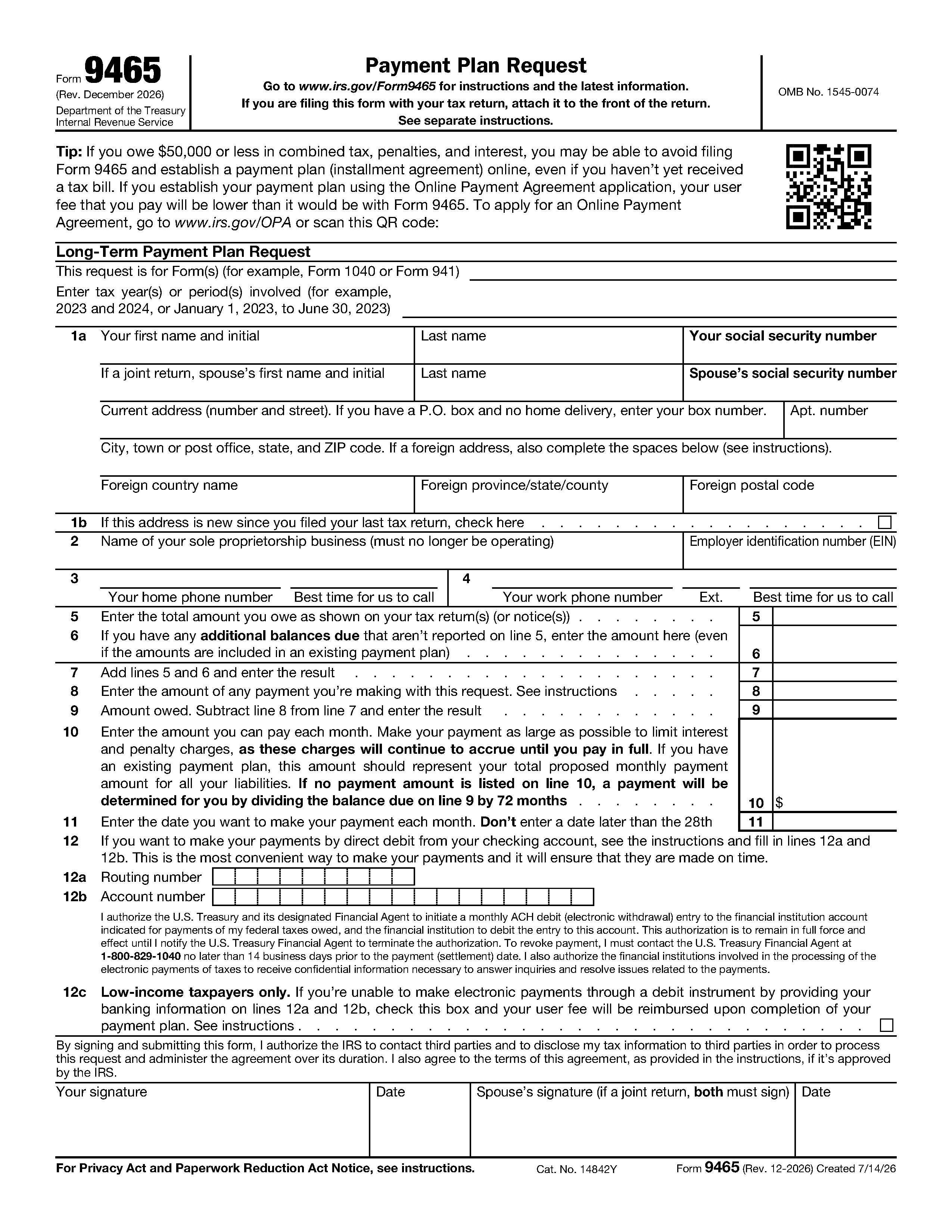
Form 9465 - Installment Agreement Request
Used to request a monthly payment plan if you cannot pay the full amount of taxes you owe. Allows taxpayers to pay their tax debt over time rather than in a lump sum.

IRS Form 8822 - Change of Address
IRS Form 8822, "Change of Address," is used by individuals to notify the IRS of a change to their home mailing address, ensuring they receive tax-related correspondence, refunds, and notices.

Form W-2 - Wage and Tax Statement
Annual statement that employers must provide to employees and the IRS reporting wages paid and taxes withheld. Essential document for filing individual income tax returns.

Form 1040-X - Amended U.S. Individual Income Tax Return
Amended U.S. Individual Income Tax Return is used to correct errors or make updates to a previously filed tax return. Whether you need to revise your income, change your filing status, or claim...
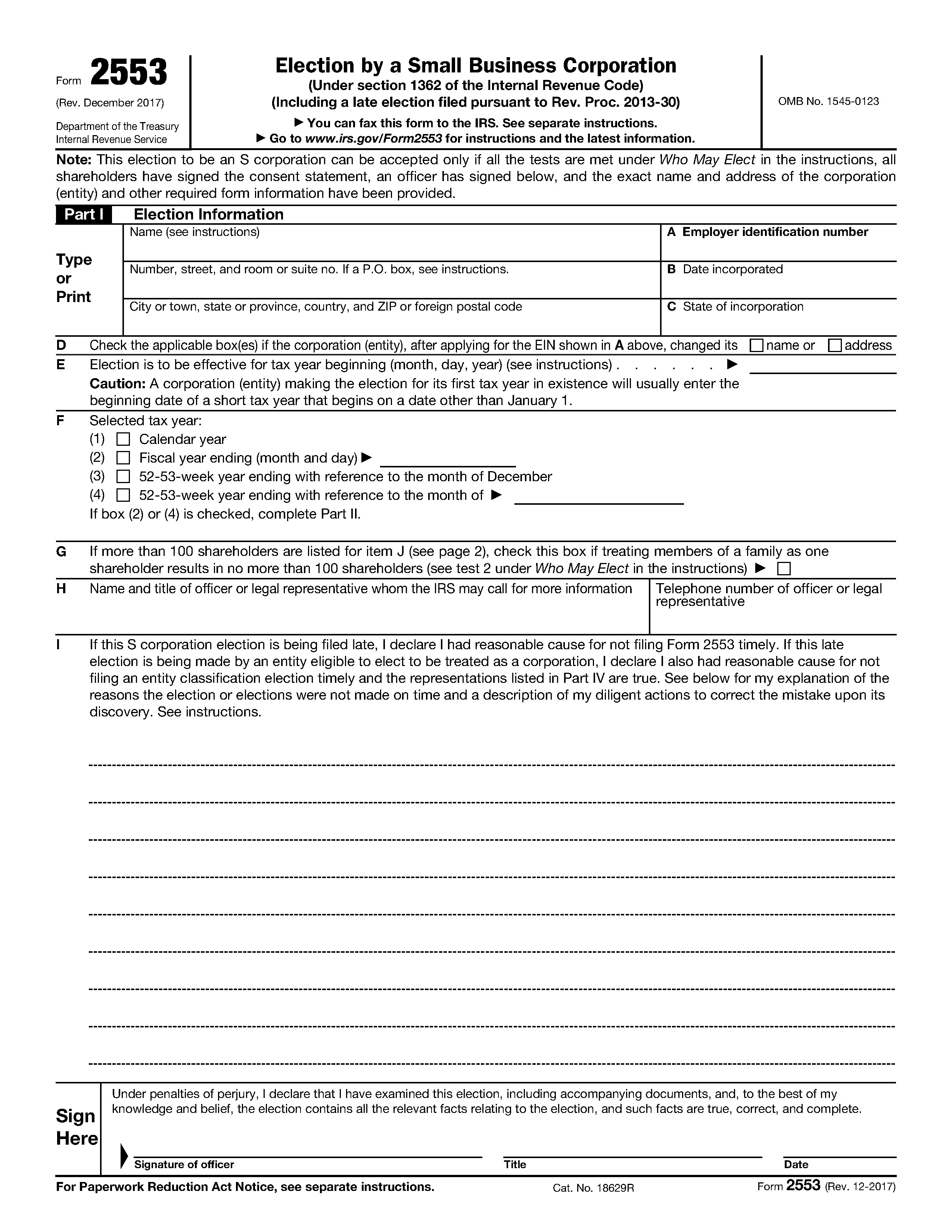
Form 2553 - Election by a Small Business Corporation
Form 2553 is the IRS election a corporation or LLC files to be taxed as an S corporation. It is signed by an officer and every shareholder, then mailed or faxed to the IRS.
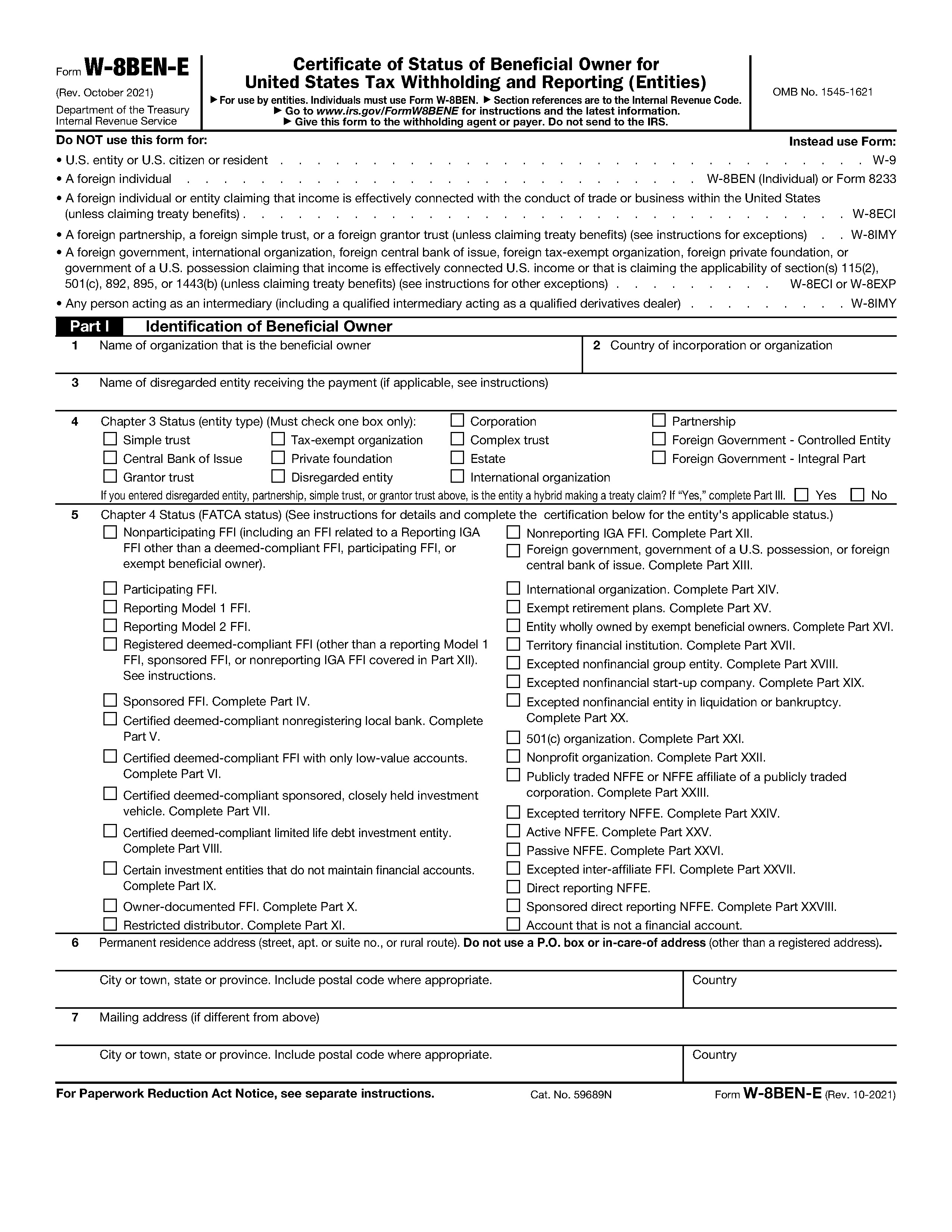
Form W-8BEN-E - Certificate of Status of Beneficial Owner for United States Tax Withholding and Reporting (Entities)
Form W-8BEN-E is the certificate a foreign entity gives a US payer to document its tax status and FATCA status. It goes to the payer, not to the IRS.

Form 1040-SR - Tax Return for Seniors
Designed for taxpayers age 65 or older, this version of the standard return features larger print and a simplified standard deduction table to make it easier to read and file manually.

Form W-4 - Employee's Withholding Certificate
Completed by employees to indicate their tax situation to their employer. Determines the amount of federal income tax to withhold from paychecks based on filing status and allowances.

Form 4506 - Request for Copy of Tax Return
Used to request an exact copy of a previously filed tax return from the IRS. Commonly needed for loan applications, immigration purposes, or replacing lost returns. Fee required.

Form 1099-DA - Digital Asset Transactions
Form 1099-DA "Digital Asset Proceeds From Broker Transactions" is a new IRS form designed to report digital asset sales, including crypto, NFTs, and stablecoins, to taxpayers and the IRS.