What Form 2210 is
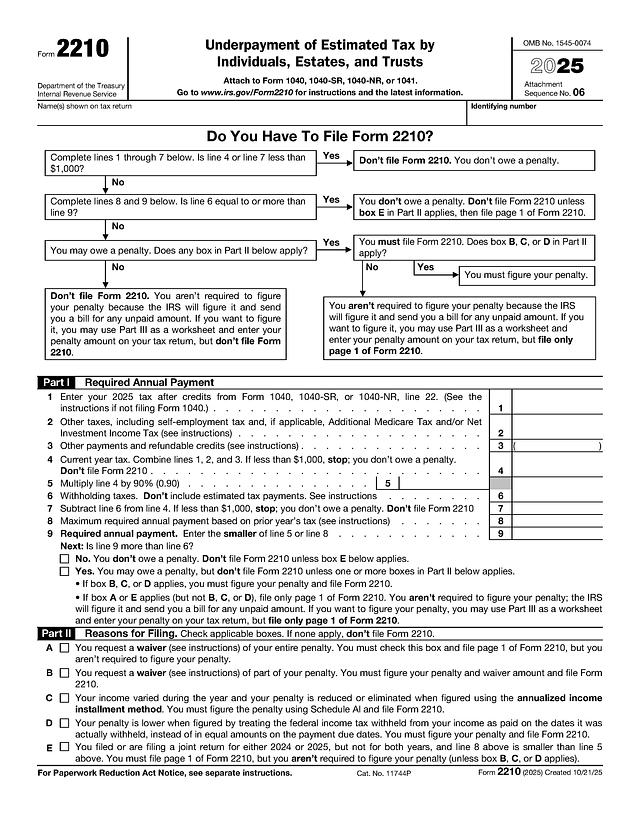
Form 2210, Underpayment of Estimated Tax by Individuals, Estates, and Trusts, is an Internal Revenue Service form used to report or work out a penalty for not paying enough tax during the year. Tax is meant to be paid as income is earned, through withholding or quarterly estimated payments. When too little is paid by the quarterly due dates, a penalty can apply. This page uses the 2025 revision, which has three pages: the filing test with Parts I and II, the Part III penalty computation, and Schedule AI.
Who typically needs it
The form is attached to Form 1040, 1040-SR, 1040-NR or 1041. It commonly comes up for freelancers, landlords, investors with large gains and people whose income arrived unevenly. The first page of the form is a flowchart: if line 4 or line 7 is less than $1,000, or if line 6 is at least line 9, the form tells you that you do not owe a penalty. In many cases the IRS figures the penalty itself and sends a bill.
What you need before you start
- Your completed 2025 return, or at least the tax after credits (Form 1040 line 22) and your other taxes, such as self-employment tax.
- Your total federal income tax withholding for the year, from your W-2, 1099 forms or other statements.
- Your 2024 return, because line 8 relies on the prior year's tax.
- Dates and amounts of every estimated payment you made (Form 1040-ES), plus any amount applied from a prior-year overpayment.
- The official instructions for Form 2210, which contain the Part III, Section B penalty worksheet.
How to fill out Form 2210 online with PDF Editify
Open this page and click "Fill Template Now". The form opens in the PDF Editify editor with its fields ready to type into. Click a field, type the value, and move on. Sign if needed (draw, type or upload a signature) and download. You can open and fill the template without a card, but downloading needs a plan: One Week Plan at $3 one-time, Standard at $10 per month or $100 per year, or Lifetime from $99 one-time. See also how to fill a PDF and how to sign a PDF.
Header
Enter the name or names exactly as shown on your tax return and the identifying number, which is your Social Security number or the employer identification number for an estate or trust.
Part I, Required Annual Payment (lines 1 to 9)
- Line 1: your 2025 tax after credits, from Form 1040, 1040-SR or 1040-NR line 22.
- Line 2: other taxes, such as self-employment tax, Additional Medicare Tax or Net Investment Income Tax.
- Line 3: other payments and refundable credits (shown in parentheses, because it is subtracted).
- Line 4: lines 1, 2 and 3 combined. Under $1,000, the form says to stop.
- Lines 5 to 7: 90% of line 4; withholding only on line 6 (no estimated payments); line 4 minus line 6 on line 7.
- Line 8: the maximum required annual payment based on the prior year's tax, worked out with the instructions.
- Line 9: the smaller of line 5 or line 8. This is your required annual payment.
Part II, Reasons for Filing
Check a box only if it applies. Box A requests a waiver of the entire penalty. Box B requests a waiver of part of it. Box C means you used the annualized income installment method (Schedule AI). Box D means you treat withholding as paid when it was actually withheld. Box E applies when you filed a joint return for either 2024 or 2025 but not both, and line 8 is smaller than line 5. If none of the boxes apply, the form says not to file it.
Part III, Section A, Figure Your Underpayment (page 2)
The four columns match the payment due dates printed on the form (4/15/25, 6/15/25, 9/15/25 and 1/15/26). Finish one column before the next.
- Line 10: required installments, normally 25% of line 9 in each column, or the Schedule AI line 27 amounts if box C applies.
- Line 11: estimated tax paid and tax withheld for each period.
- Lines 12 to 18: the carry-forward arithmetic, ending with the underpayment (line 17) or overpayment (line 18) for each column.
Part III, Section B, Figure the Penalty
Line 19 takes the total penalty from the worksheet in the official instructions. That amount goes on Form 1040 or 1040-SR line 38, or Form 1041 line 27.
Schedule AI (page 3)
Only complete this if you check box C. Line 27 carries to Part III line 10.
Signing, and where and how to submit
Form 2210 has no signature line of its own. It is attached to the return you sign, whether filed on paper or electronically. On paper, attach it in order of Attachment Sequence No. 06. The official forms page is IRS About Form 2210.
Deadlines and fees
- The 2025 form lists installment due dates of April 15, 2025, June 15, 2025, September 15, 2025 and January 15, 2026. Source: the 2025 Form 2210, as of November 20, 2026.
- There is no fee to file the form. The penalty itself is charged at an interest rate the IRS sets each quarter, and the rate is described in the official instructions. Source: IRS instructions for Form 2210, as of November 20, 2026.
Common mistakes
- Filing the form when line 4 or line 7 is under $1,000, or when none of the Part II boxes apply.
- Putting estimated tax payments on line 6. That line is for withholding only.
- Entering line 3 as a positive number when it is a deduction.
- Forgetting that box C requires Schedule AI, and that Schedule AI line 27 feeds Part III line 10.
For decisions about waivers or which method to use, rely on the official instructions or a qualified tax professional.