What a limited power of attorney is
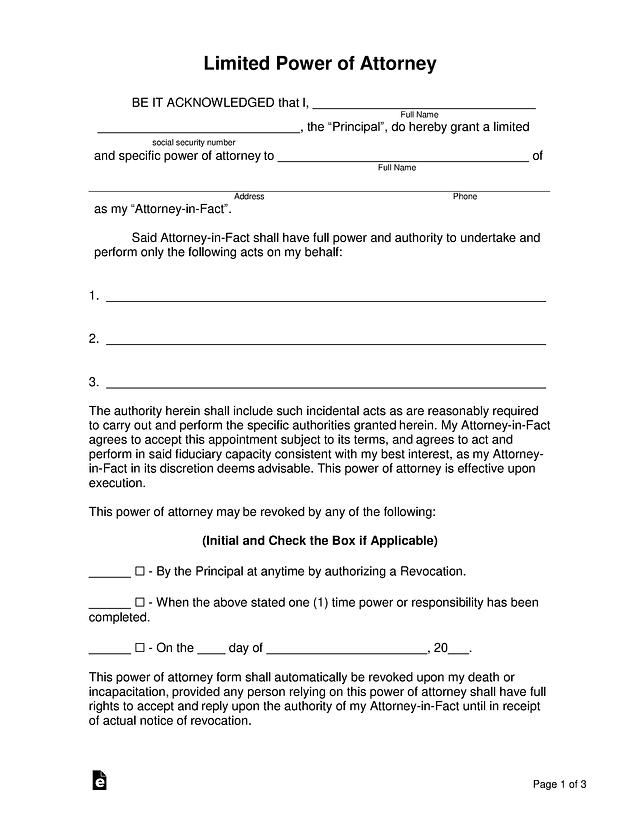
A limited (or special) power of attorney lets someone act for you on specific tasks only. This 3-page template gives the attorney-in-fact authority to "undertake and perform only the following acts", listed on three numbered lines you write yourself, plus incidental acts reasonably needed to complete them. Anything you do not list is outside the agent's authority.
The document is effective when signed and is automatically revoked on your death or incapacitation, so it is not durable. For broad, ongoing authority, a general power of attorney is the wider option. This is a general private template, not a state-issued form.
Who typically uses it
People who cannot be present for one transaction or a short list of them: signing closing papers on a property sale, handling a single bank matter, picking up or selling a car, or dealing with a tax office. For car title and registration matters, many states have their own forms; see the vehicle power of attorney page for examples.
What to have ready
- Your full legal name
- The attorney-in-fact's full name, address and phone number
- A precise description of each act you are authorizing (property address, account, case or vehicle details as relevant)
- How you want the power to end
- Two witnesses and a notary, since the form has blocks for both
How to fill it out online with PDF Editify
Click "Fill Template Now", type into the fields, check and initial your revocation choices, sign, and download the PDF. Our step-by-step limited power of attorney guide goes into more detail. The fields as they appear:
Grant of authority
After "BE IT ACKNOWLEDGED that I", enter your full name as Principal, then the attorney-in-fact's full name, address and phone. On lines 1, 2 and 3, describe each act the agent may perform. Be specific; vague wording such as "handle my affairs" defeats the purpose of a limited power.
Revocation
Initial and check every option that applies: revocable by you at any time through a written revocation, ends when the one-time task has been completed, or ends on a specific day, month and year.
State Law and signature
Enter the state whose law governs the document, then the signing day, month and year, your signature and printed name.
Acceptance, witnesses and notary
The attorney-in-fact fills in the Acceptance of Appointment with a signature and printed name. Two witnesses sign and print their names, addresses and city, state and ZIP code. Page 3 is a notary acknowledgment with the state, county, date and the principal's name.
Who will accept it, and state rules
A limited power of attorney is only useful if the person you send it to accepts it, so check their requirements first. Examples as of October 2026:
- Florida requires every power of attorney to be signed by the principal and two subscribing witnesses and acknowledged before a notary (Fla. Stat. 709.2105).
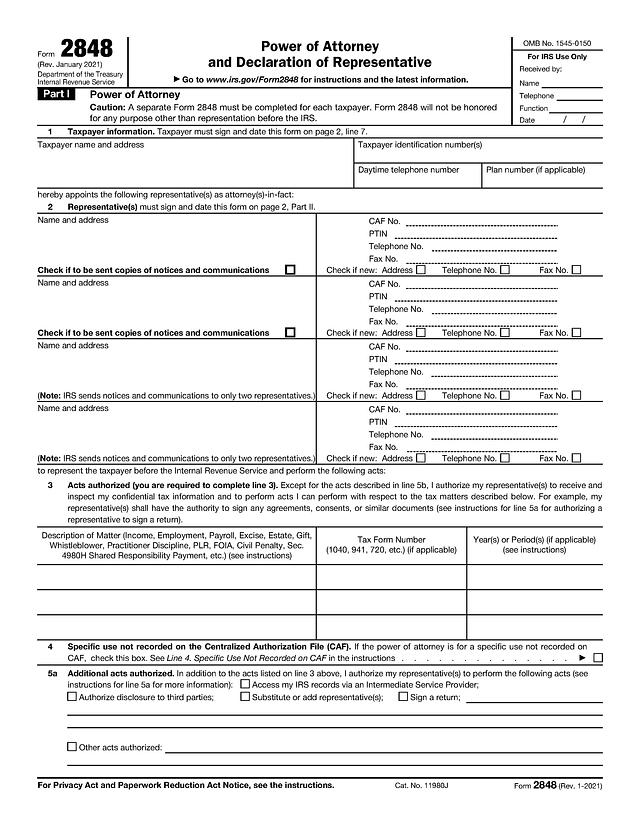
- The IRS accepts a power of attorney other than Form 2848 if it meets IRS requirements, but it is only recorded on the Centralized Authorization File with a completed Form 2848 attached (IRS Instructions for Form 2848).
- The California DMV accepts a restricted power of attorney limited to one type of transaction, such as transfer of ownership, but a power of attorney cannot be used there to disclose odometer mileage (California DMV procedures manual, section 1.125).
Some states require a statutory form or specific wording for financial powers of attorney. Check your state's rules before signing, and get legal advice if the transaction is significant.
Common mistakes
- Describing the authorized acts too broadly or too vaguely
- Leaving the end date blank after checking the specific-date option
- Forgetting the attorney-in-fact's acceptance signature
- Not confirming in advance that the bank, title company or agency will accept the form
- Using it for situations where you need authority to continue after incapacity