What this lease agreement is
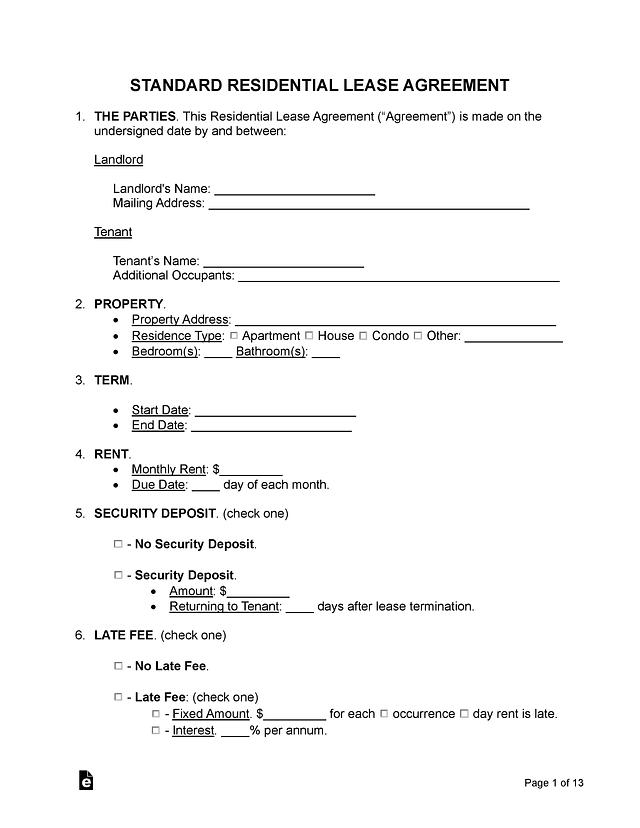
This Standard Residential Lease Agreement is a 13-page fixed-term lease for renting a home, apartment, condo, or other residence. It is a general private template, not a form issued by any government agency, so there is no official version or filing office. It works as a contract between the landlord and tenant, and section 23(g) says it is governed by the laws of the place where the property is located. Most of the first 22 sections are fill-in blanks and checkboxes; sections 23-27 are pre-written terms.
Who uses it
Individual landlords and small property owners use it to set out rent, deposit, and house rules for a single unit. Tenants use the same document to review what they are agreeing to before signing. There are signature lines for one landlord and two tenants.
What to have ready
- Full names of the landlord, each tenant, and any additional occupants
- The property address, residence type, and number of bedrooms and bathrooms
- Lease start and end dates, monthly rent, and the rent due day
- Deposit, late fee, NSF fee, pet, and parking amounts you plan to charge
- Payment details for any methods you accept (PayPal, Venmo, or Zelle contact)
- The year the building was built, which matters for the federal lead paint disclosure
How to fill out the lease online
Click "Fill Template Now", type into each blank, tick the checkboxes, sign, and download the PDF. Here is what each part of this lease covers, and our lease filling guide has more detail.
Sections 1-4: Parties, property, term, and rent
Section 1 names the landlord (with mailing address), the tenant, and additional occupants. Section 2 describes the property. Section 3 sets the start and end dates, and section 4 sets the monthly rent and the day of the month it is due.
Sections 5-10: Money terms
Section 5 chooses no deposit or a deposit, with the amount and the number of days after the lease ends for its return. Section 6 sets no late fee, a fixed fee per occurrence or per day, or interest at a yearly rate. Section 7 covers the NSF (bounced check) fee, section 8 an early move-in date with prorated rent, section 9 any required prepayment of rent, and section 10 the payment methods accepted.
Sections 11-19: Property rules
These cover pets (number, types, weight limit, and a refundable or non-refundable deposit), smoking, parking spaces and fees, which rooms are furnished, which appliances are included, which utilities and services the landlord pays, any renters insurance minimum, whether a move-in inspection is required, and whether subletting is allowed with consent.
Sections 20-22: Notices, extra terms, and disclosures
Section 20 sets the notice addresses. Section 21 is open space for additional terms. Section 22 lists documents the landlord will deliver, including the lead-based paint disclosure, the "Protect Your Family From Lead in Your Home" pamphlet, a move-in checklist, and up to four others.
Sections 23-27 and the final pages
Section 23 defines terms such as abandonment, guests (stays of no more than 48 hours), security deposit handling, and renters insurance. Section 24 adds terms such as right of entry with 24 hours' notice or the period required by law, active military termination, and holdover. Section 25 covers default, 26 prohibited actions, and 27 the entire agreement. Page 12 holds the signatures, and page 13 is an "Amount Due at Signing" summary that totals first month's rent, deposit, prorated rent, prepaid rent, parking, and pet deposit.
State law varies: a few examples
Several clauses in this template defer to "Governing Law", and rules for deposits and fees differ by state. Some examples, as of October 2026:
- California: Civil Code section 1950.5 generally limits security deposits to one month's rent, with a two-month limit for certain small landlords, and requires the deposit or an itemized statement within 21 days after the tenant moves out.
- New York: General Obligations Law section 7-108 caps deposits at one month's rent for most dwellings and requires an itemized statement and return of the balance within 14 days after the tenant vacates.
- Florida: Statutes section 83.49 requires return of the deposit within 15 days if no claim is made, or written notice of a claim within 30 days.
- Federal: for most housing built before 1978, the EPA lead disclosure rule requires landlords to disclose known lead-based paint hazards, give tenants the lead pamphlet, and include a lead warning statement with the lease. Some leases, such as those of 100 days or less, are exempt.
Cities and counties can add their own rules, such as rent stabilization. Check the law where the property is, or ask a local attorney or housing agency, before choosing amounts.
Signing the lease
The landlord and each tenant sign and date page 12 and print their names. You can add signatures with our online signing tool, and our guide on how to sign a lease online covers the process. Give every party a complete copy, including any disclosures listed in section 22.
Common mistakes
- Checking both options in a "check one" section, or none
- Entering a deposit or late fee above the limit your state or city allows
- Skipping the lead disclosure for a pre-1978 building
- Leaving the Amount Due at Signing total out of sync with sections 4-13
- Forgetting the second tenant's signature when two adults are on the lease