What a medical power of attorney is
A medical power of attorney names a health care agent to make medical decisions for you if you cannot make them yourself. Under this 5-page template, the agent's authority starts once your doctor certifies in writing that you can no longer make health care decisions, and the agent can consent to or refuse treatment, including decisions about life-sustaining treatment, except where you limit that authority. You keep making your own decisions while you are able to.
It covers health care only. Money and property matters need a separate financial document such as a durable power of attorney or another financial power of attorney. This is a general private template, not a state-issued form, and states use different names for this document, such as health care proxy, advance health care directive or designation of health care surrogate.
Who typically uses it
Adults planning ahead for surgery, illness or aging, and anyone who wants a specific person, rather than whoever is available, to speak for them with doctors and hospitals. The form says your agent must be at least 18. Parents arranging temporary care for a child use a separate minor power of attorney instead.
What to have ready
- Your name and mailing address
- Your agent's name, mailing address, phone and email
- Names, addresses and phone numbers of up to two alternate agents
- Any decisions you do not want your agent to make
- Where the original will be kept and who should get copies
- A notary, or two qualified adult witnesses
How to fill it out online with PDF Editify
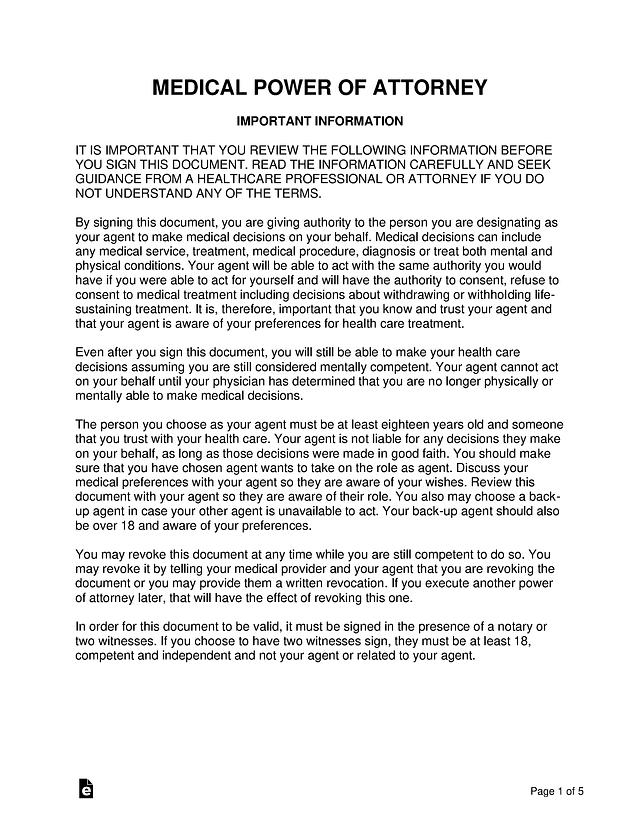
Click "Fill Template Now", type into the fields, sign, and download the PDF. Page 1 is "Important Information" to read before signing. Our medical power of attorney guide has more background. The sections:
- I. Appointment of Health Care Agent. Your name and mailing address, your agent's name and mailing address, and the agent's phone and email.
- II. Limitations on My Agent. Open text after "all medical decisions on my behalf EXCEPT". Leave it blank if you set no limits.
- III. Appointment of Alternate Agent. First and Second Alternate Agent, each with name, address and phone.
- IV. Original and Copies. Where the original is filed and who receives copies.
- V. Duration. Check "In Perpetuity" (ends at death or written revocation) or "End Date" with a date.
- VI. Prior Medical Power of Attorney. Preprinted; signing revokes any earlier medical powers of attorney.
- VII and VIII. Legal Requirements and Execution. Your signature, printed name and date, then the notary acknowledgment.
- Witness Statement. Two witnesses sign, print their names, date and address, confirming they are not your agent, not related to you, not entitled to your estate, and not your attending physician or a health care facility employee involved in your care.
Signing requirements and state forms
Rules for health care agent documents are set by each state, and some states have a statutory form. Examples as of October 2026:
- Texas requires a medical power of attorney to be in substantially the statutory form (Tex. Health and Safety Code 166.164) and signed before two qualified witnesses or acknowledged before a notary (section 166.154). Texas HHS publishes the official MPOA form.
- New York uses a health care proxy signed in front of two adult witnesses, and the agent cannot be a witness (N.Y. Public Health Law 2981). The NY Department of Health provides a proxy form.
- California accepts a notary or two qualified witnesses for a paper advance directive, but an electronic one must be notarized (Cal. Prob. Code 4673).
- Florida requires two adult witnesses for a health care surrogate designation, at least one of whom is not your spouse or blood relative, and the surrogate cannot be a witness (Fla. Stat. 765.202).
Check whether your state requires its own form before relying on this template. Questions about treatment choices are for your doctor, and questions about the document's legal effect are for a lawyer.
Common mistakes
- Naming an agent who has not agreed to serve or does not know your wishes
- Using a witness who is related to you or works for your care provider
- Checking both duration options, or "End Date" with no date
- Keeping the only copy where no one can find it
- Signing electronically where your state requires notarization for electronic directives