What a durable power of attorney is
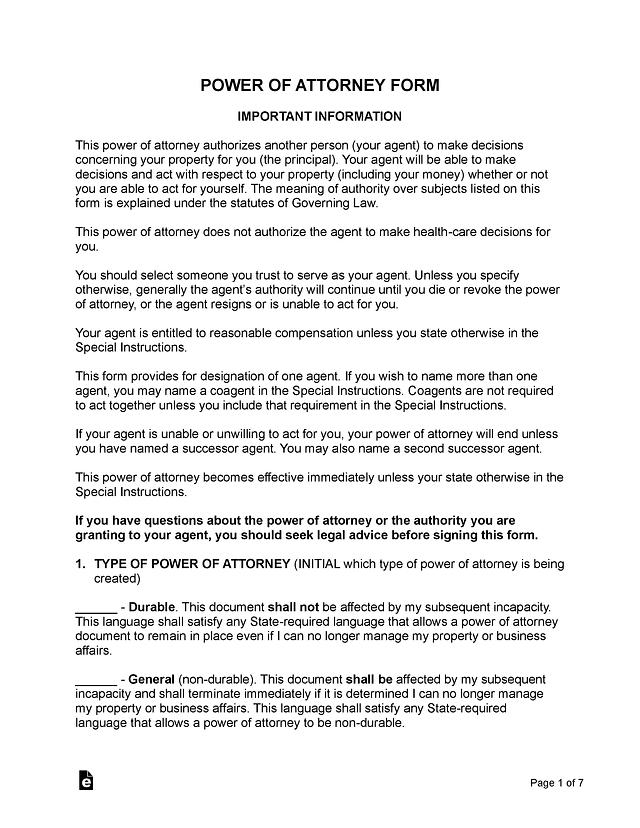
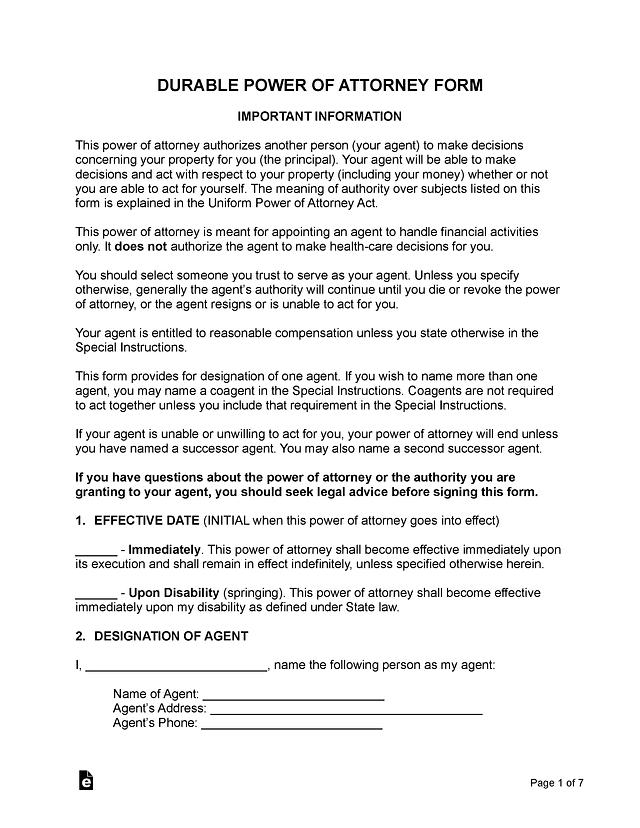
A durable power of attorney names an agent to handle your finances and keeps working if you later become incapacitated. On this 7-page template, Section 10, "Not Affected by Incapacity", provides that the document "shall not be affected by my subsequent incapacity." The form states that it is for financial matters only and does not authorize health care decisions; a medical power of attorney covers those.
The form follows the Uniform Power of Attorney Act model and refers to that act for the meaning of each power. It is a general private template, not a state-issued form. Unlike a general (non-durable) power of attorney, it is meant to stay in effect after incapacity, until you revoke it or die, or the agent stops serving.
Who typically uses it
People planning for aging or a serious illness, and anyone who wants a trusted person able to pay bills, manage accounts, handle property or deal with taxes without a court-appointed conservator if they can no longer act themselves.
What to have ready
- Names, addresses and phone numbers for you, your agent and up to two successor agents
- The subjects you want the agent to handle
- Any special instructions, such as a co-agent or limits on compensation
- Optional nominees for conservator or guardian
- The governing state, and witnesses or a notary as your state requires
How to fill it out online with PDF Editify
Click "Fill Template Now", type into the fields, initial your choices, sign, and download the PDF. For a longer walkthrough, see our guide to filling out a durable power of attorney. The sections:
- Effective Date. Initial "Immediately" or "Upon Disability (springing)", which takes effect on your disability as defined under state law.
- Designation of Agent. Your name, then the agent's name, address and phone.
- Designation of Successor Agent(s) (optional). A successor and a 2nd successor agent.
- Grant of General Authority. Initial each subject: Real Property, Tangible Personal Property, Stocks and Bonds, Commodities and Options, Banks and Other Financial Institutions, Operation of Entity or Business, Insurance and Annuities, Estate, Trusts, and Other Beneficial Interests, Claims and Litigation, Personal and Family Maintenance, Benefits from Governmental Programs or Civil or Military Service, Retirement Plans, Taxes, or All Preceding Subjects.
- Grant of Specific Authority (optional). Separate initials for trust changes, gifts, survivorship rights, beneficiary designations, delegation, joint and survivor annuity waivers, fiduciary powers, electronic communications and disclaimers. The form warns these can reduce your property or change how it passes at death.
- Limitation on Agent's Authority (preprinted) and Special Instructions lines.
- Nomination of Conservator or Guardian (optional). A guardian of your estate and a guardian of your person.
- Reliance, Not Affected by Incapacity and Governing Law. Fill in the governing state.
- Signature and Acknowledgment. Signature, date, printed name, address and phone, then the witness attestation, notary acknowledgment and "prepared by" block.
Pages 6-7, "Important Information for Agent", explain the agent's duties and when authority ends.
Durability and signing rules vary by state
States differ on the words that make a power of attorney durable, on signing formalities and on springing powers. Examples as of October 2026:
- Texas requires a durable power of attorney to contain durable language and be acknowledged before a notary or other officer authorized to take acknowledgments (Tex. Est. Code 751.0021). Texas also has a statutory durable power of attorney form set out in Tex. Est. Code 752.051.
- California defines a durable power of attorney by language such as "This power of attorney shall not be affected by subsequent incapacity of the principal" or similar words (Cal. Prob. Code 4124).
- Florida has its own durability wording (Fla. Stat. 709.2104) and, for documents signed on or after October 1, 2011, does not give effect to a power of attorney that springs on a future event such as incapacity (Fla. Stat. 709.2108).
Several states have mandatory statutory forms or required wording. Check whether your state does before signing a general template, and talk to a lawyer if you have questions about the powers you are granting.
Common mistakes
- Choosing the springing option without checking whether your state allows it
- Initialing "All Preceding Subjects" by accident
- Granting gift or beneficiary powers without reading the caution in Section 5
- Leaving the governing state blank
- Signing without the notary or witnesses your state requires