What this power of attorney form does
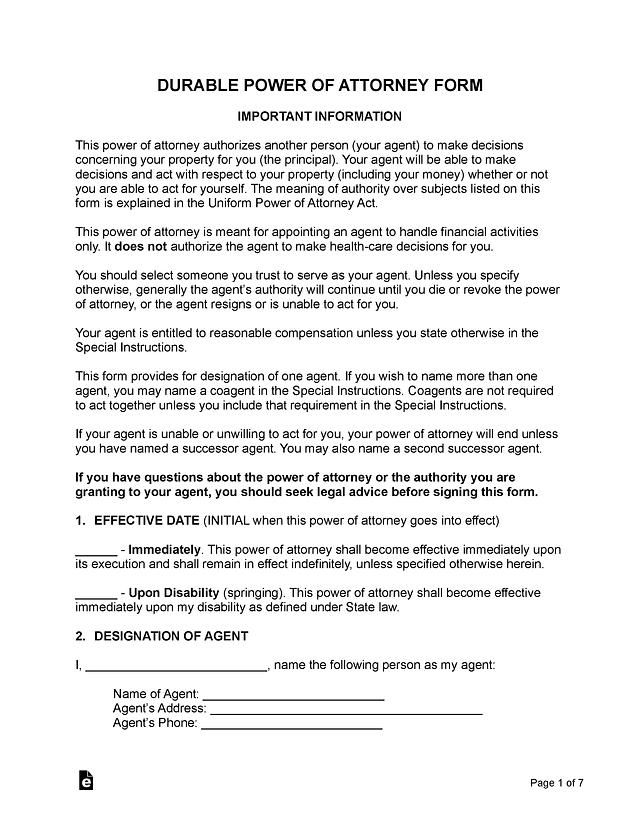
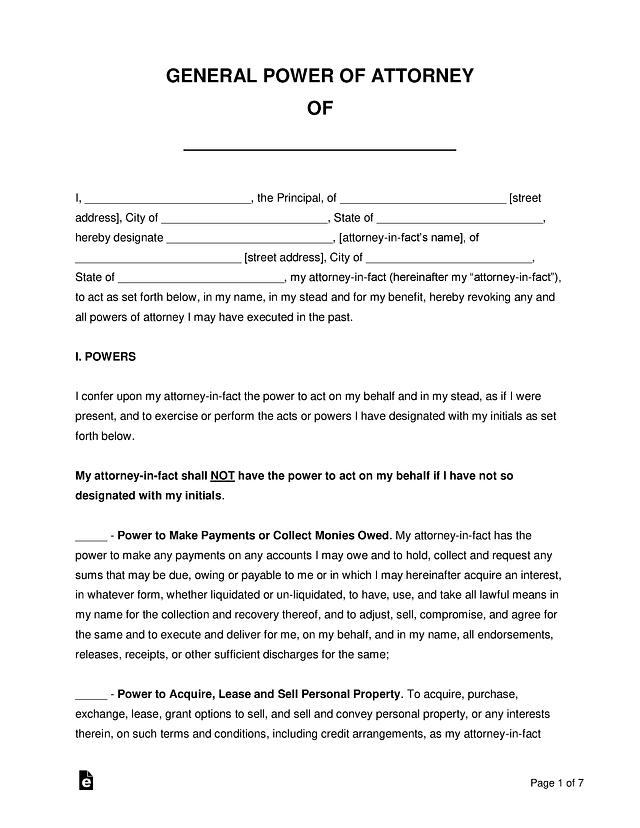
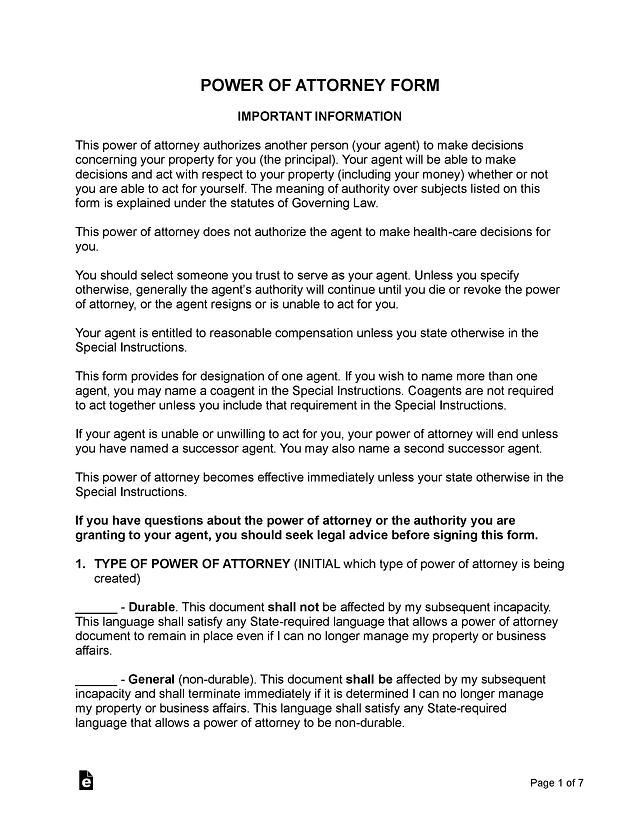
This is a 7-page financial power of attorney. It lets you, the principal, name an agent to make decisions about your property and money. Its first section asks you to choose the type: initial "Durable" if the agent's authority should continue if you later become incapacitated, or "General (non-durable)" if it should end at that point. The form states that it does not authorize health care decisions; that takes a separate document such as a medical power of attorney.
The wording follows the Uniform Power of Attorney Act model, with a "Governing Law" state you fill in. It is a general private template for use in many states, not a form issued by any state or agency.
Who typically uses it
People planning ahead for illness, aging, long travel or deployment, and families who want one trusted person to pay bills, manage accounts, deal with property or run a business. If you only need help with one transaction, a limited power of attorney is narrower. If you already know the authority must survive incapacity, the durable power of attorney form has that clause built in.
What to have ready
- Full names, addresses and phone numbers for you, your agent and up to two successor agents
- A list of the subject areas you want the agent to handle
- Contact details for anyone you want to nominate as conservator or guardian (optional)
- The state whose law will govern the document
- Witnesses and a notary, if your state requires them
How to fill it out online with PDF Editify
Click "Fill Template Now", type into the fields, add your initials and signature, then download the finished PDF. The sections appear on the form in this order:
- Type of Power of Attorney. Initial Durable or General (non-durable), not both.
- Designation of Agent. Your name, then the agent's name, address and phone.
- Designation of Successor Agent(s) (optional). A successor and a 2nd successor who step in if the agent cannot or will not act.
- Grant of General Authority. Initial each subject you grant, from Real Property, Stocks and Bonds and Banks and Other Financial Institutions through Insurance and Annuities, Claims and Litigation, Government Benefits, Retirement Plans and Taxes. "All Preceding Subjects" grants every one of them.
- Grant of Specific Authority (optional). Separate initials for powers such as creating or revoking an inter vivos trust, making gifts, changing rights of survivorship or beneficiary designations, delegating authority and accessing electronic communications. The form cautions that these can significantly reduce your property or change how it is distributed at death.
- Limitation on Agent's Authority (preprinted) and Special Instructions, open lines where you can name a co-agent, address compensation or add limits.
- Effective Date. Initial "Immediately" or "Upon Disability (springing)".
- Nomination of Conservator or Guardian (optional). Name, address and phone for a guardian of your estate and a guardian of your person.
- Governing Law. The state whose law applies.
- Signature and Acknowledgment. Your signature, date, printed name, address and phone, followed by a two-person witness attestation, a notary acknowledgment and a "prepared by" block.
Pages 6-7 are "Important Information for Agent", which lists the agent's duties and the events that end the agent's authority. Share them with your agent before they accept.
Signing requirements depend on your state
The form includes both a witness block and a notary block because execution rules differ. Some examples, as of October 2026:
- New York requires the principal's signature to be notarized and two witnesses who are not agents or gift recipients, and the document must follow the wording of the statutory short form's caution and agent notices (N.Y. Gen. Oblig. Law 5-1501B; the form is in section 5-1513).
- California accepts either a notary acknowledgment or two qualified witnesses (Cal. Prob. Code 4121).
- Florida requires two subscribing witnesses and a notary (Fla. Stat. 709.2105). A Florida power of attorney that is set to take effect at a future date or on a future event such as incapacity is not effective, apart from a narrow exception for documents signed before October 1, 2011 (Fla. Stat. 709.2108).
Several states publish a statutory form that must be used or closely followed. Before signing, check your state's statutes or court self-help pages to see whether yours has one. If you are unsure which powers to grant, the form itself recommends getting legal advice first.
Common mistakes
- Initialing both Durable and General, or both effective-date options
- Initialing "All Preceding Subjects" without meaning to grant every subject on the list
- Leaving the Governing Law state blank
- Choosing a witness who is related to you, named as agent, or entitled to part of your estate, which the witness attestation says they are not
- Not checking whether your bank or county recorder needs an original signed and notarized copy