What this multi-member operating agreement is
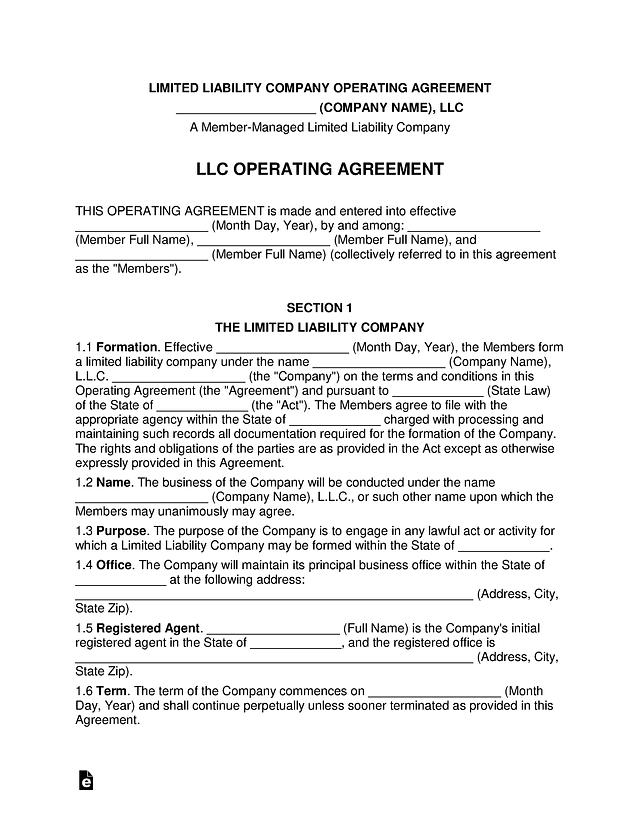
This is a 13-page operating agreement for a member-managed limited liability company with three named members. It is a general private template, not a government form. Section 1.1 says the members will file the documents required to form the company with the appropriate state agency; this agreement itself is the members' private contract on ownership, money, management, and transfers. Section 10.2 makes it subject to the laws of the state you enter.
Who uses it
Co-owners forming an LLC together, or an existing LLC with several owners that wants its terms in writing. The template has blanks for three members on the first page, the signature page, and each schedule.
What to have ready
- The company name, state, and state law under which the LLC is formed
- The effective date and principal office address
- The registered agent's name and registered office address
- Each member's full name, address, capital contribution, and ownership percentage
- An agreed value for each member's interest, for Schedule 3
How to fill out the agreement online
Click "Fill Template Now", type into the blanks, sign, and download the PDF. Our multi-member LLC operating agreement guide walks through it in more depth. Here is what each section covers.
Opening and Section 1, The Limited Liability Company
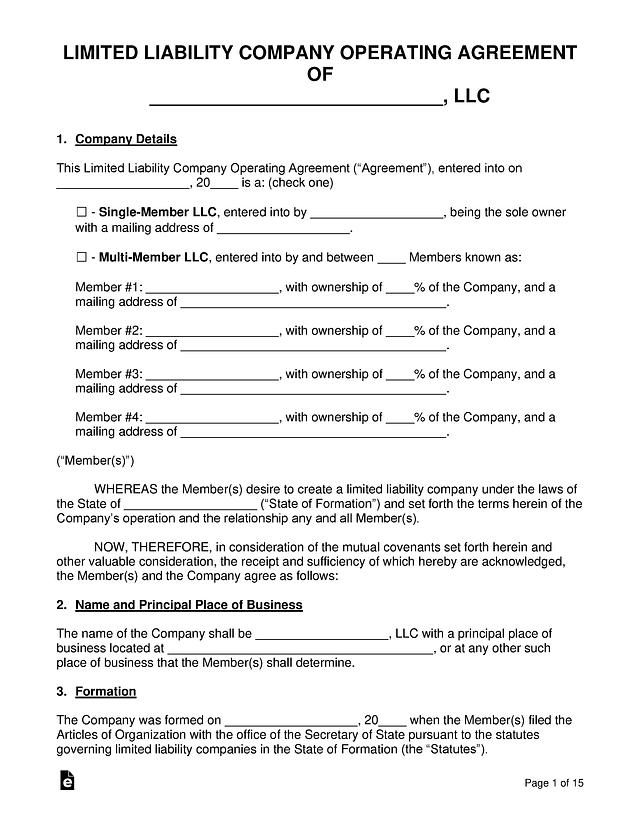
Enter the company name, the effective date, and the three members' full names. Sections 1.1-1.6 ask for the formation date, the state law (the "Act") and state, the principal office address, the registered agent and registered office, and the start date of the company's term. Section 1.7 points to Schedule 1, and 1.8 requires unanimous written consent to admit new members.
Sections 2-4: Capital, profits, and indemnification
Initial contributions are listed on Schedule 2, and no member must contribute more without unanimous written consent. Profits and losses are allocated by each member's capital interest on Schedule 2. Section 4 covers indemnification of members, managers, employees, and agents.
Sections 5-7: Management and accounts
Decisions are made by a majority in interest of the members. Salaries need written approval by a majority. The fiscal year is the calendar year, and company funds go in a separate account in the company's name.
Section 8: Transfers and death buyout
Transfers generally need consent of a majority of the other members. Alternatively, a member can offer the interest to the other members, who have 30 days to buy it before it can be sold to an outsider on the offered terms. On a member's death, the company may buy the interest by notice within 180 days, using the value on Schedule 3, or an appraisal process if that value is more than two years old.
Sections 9-10: Dissolution and general provisions
Section 9 lists dissolution events and the order for paying creditors and members. Section 10 requires all members' written approval for amendments and covers governing law, attorney fees, severability, and notices.
Signatures, schedules, and notary page
Each member prints their name and signs. Schedule 1 lists members and addresses, Schedule 2 lists contributions and ownership percentages, and Schedule 3 records the valuation of each interest; each schedule has its own date and signatures. The last page is a notary acknowledgment completed by a notary. You can sign with our PDF signing tool.
State law varies: a few examples
LLCs are created under state law, and states treat operating agreements differently. Some examples, as of October 2026:
- New York: LLC Law section 417 says the members of an LLC shall adopt a written operating agreement, and that it may be entered into before, at the time of, or within 90 days after the articles of organization are filed.
- California: Corporations Code section 17701.02 defines an operating agreement as one that may be oral, in a record, implied, or a combination, including one with a sole member.
- Delaware: Title 6, section 18-101 defines an LLC agreement as written, oral, or implied, and says a one-member agreement is not unenforceable just because only one person is a party.
For federal taxes, the IRS LLC page explains that by default a single-member LLC is disregarded as separate from its owner and an LLC with at least two members is classified as a partnership, unless the LLC elects otherwise on Form 8832. The IRS also notes that state rules differ, so check with your state. Decisions about structure, tax elections, or unusual terms are best reviewed with a qualified attorney or tax professional.
Common mistakes
- Leaving Schedule 2 inconsistent: it states a $100 total initial contribution in pre-printed text, so make sure the amounts you enter match what the members actually agreed
- Ownership percentages that do not total 100%
- Skipping Schedule 3, which the death buyout in section 8.5 relies on
- Using the template as-is for more than three members without adding signature and schedule lines