What a vehicle power of attorney is
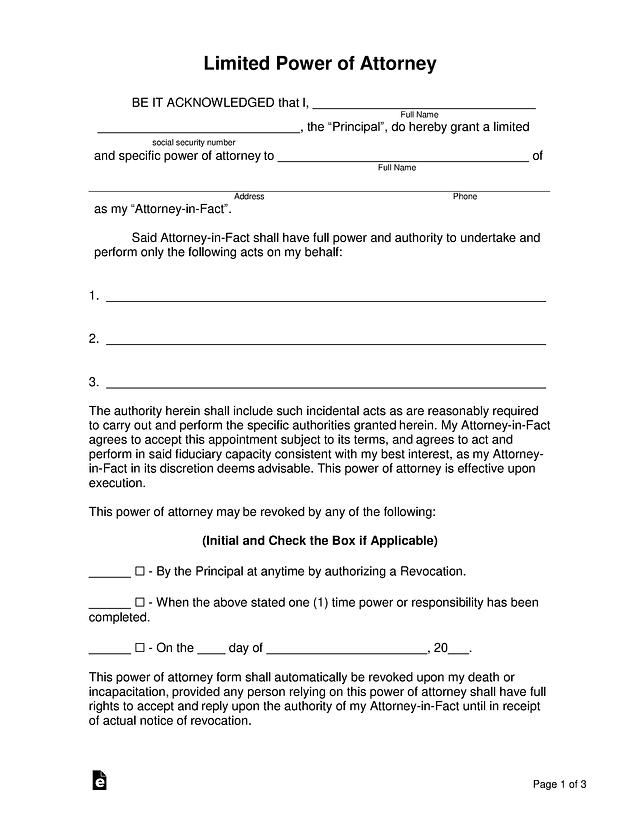
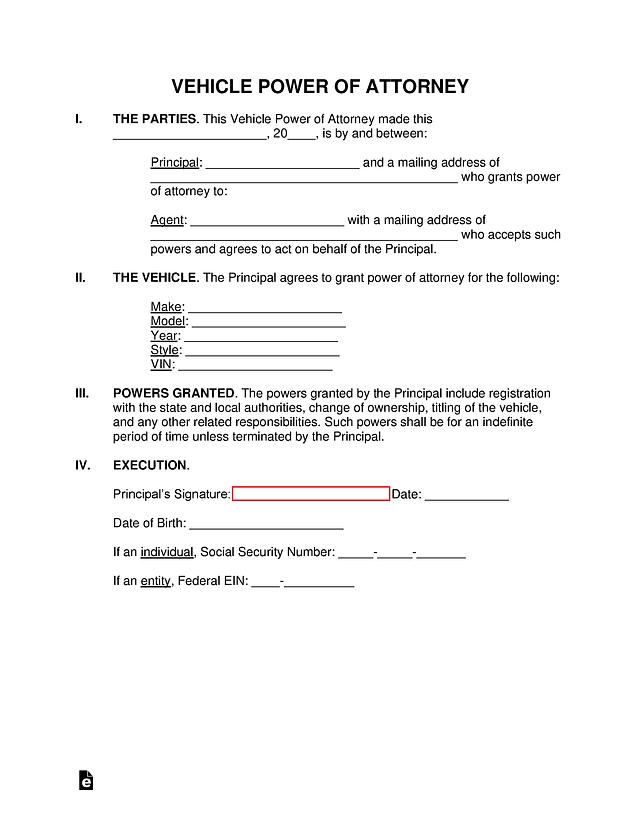
A vehicle power of attorney lets an agent handle paperwork for one specific vehicle on the owner's behalf. On this 2-page template, the powers granted are registration with state and local authorities, change of ownership, titling, and related responsibilities. Those powers last for an indefinite period unless you terminate them. It is a type of limited power of attorney tied to a single vehicle identified by its VIN.
This is a general private template, not a DMV form. Many state motor vehicle agencies publish their own power of attorney forms, and some transactions require them.
Who typically uses it
Owners who cannot visit the DMV in person, for example while living out of state, deployed or traveling, and people selling or buying a car through a family member, friend or business that will handle titling and registration. For broader authority beyond one vehicle, a general power of attorney includes a motor vehicle power alongside others.
What to have ready
- Your name and mailing address, and the agent's name and mailing address
- The vehicle's make, model, year, style and VIN, exactly as on the title
- Your date of birth, and your Social Security number if you are an individual or the Federal EIN if the owner is a business
- A notary for the acknowledgment on page 2
How to fill it out online with PDF Editify
Click "Fill Template Now", type into the fields, sign, and download the PDF. Our vehicle power of attorney guide walks through it in more detail. The sections:
- I. The Parties. The date the document is made, the Principal's name and mailing address, and the Agent's name and mailing address.
- II. The Vehicle. Make, Model, Year, Style and VIN. Copy the VIN from the title or registration and check every character.
- III. Powers Granted. Preprinted. Read it to confirm it covers what you need.
- IV. Execution. Your signature, the date, your date of birth, and either a Social Security number (individual) or Federal EIN (entity).
- Notary Acknowledgment. Completed by the notary: state, county, date, the officer's name and title, the signer's name, and the state named in the certificate.
Because the form asks for a Social Security number, share the completed PDF only with the agent and the agency that needs it.
DMV forms and odometer rules
Check your state DMV's requirements before using a general template. Examples as of October 2026:
- California. The DMV accepts its own Power of Attorney form REG 260 as well as restricted and general powers of attorney. A vehicle power of attorney must contain the VIN, and a power of attorney cannot be used to disclose odometer mileage (California DMV procedures manual, section 1.125).
- Texas. The TxDMV form VTR-271, Limited Power of Attorney for Eligible Motor Vehicle Transactions, requires original signatures in black or blue ink and photo ID copies when used to apply for title. It cannot be used in a dealer transaction for a vehicle subject to federal odometer disclosure; the secure form VTR-271-A applies instead (TxDMV form VTR-271).
- Federal odometer rule. A seller can give a power of attorney for mileage disclosure only in limited cases, such as when a lienholder holds the title or the title is lost, and the disclosure must be made on the power of attorney form issued by the state where the transfer occurs (49 CFR 580.13).
This template does not include an odometer disclosure section. If the transfer requires one, use your state's secure form, and contact your DMV if you are unsure which form applies.
Common mistakes
- A VIN that does not match the title
- Signing before you are in front of the notary
- Using this form where the DMV requires its own secure power of attorney
- Entering an SSN when the owner is a business (use the EIN)
- Forgetting to revoke it once the transaction is finished, since the powers are indefinite