Form 1040-V - Payment Voucher for Individuals
Form 1040-V is the payment voucher mailed with a check or money order for a balance due on Form 1040, 1040-SR or 1040-NR. Individual taxpayers who pay by mail use it.
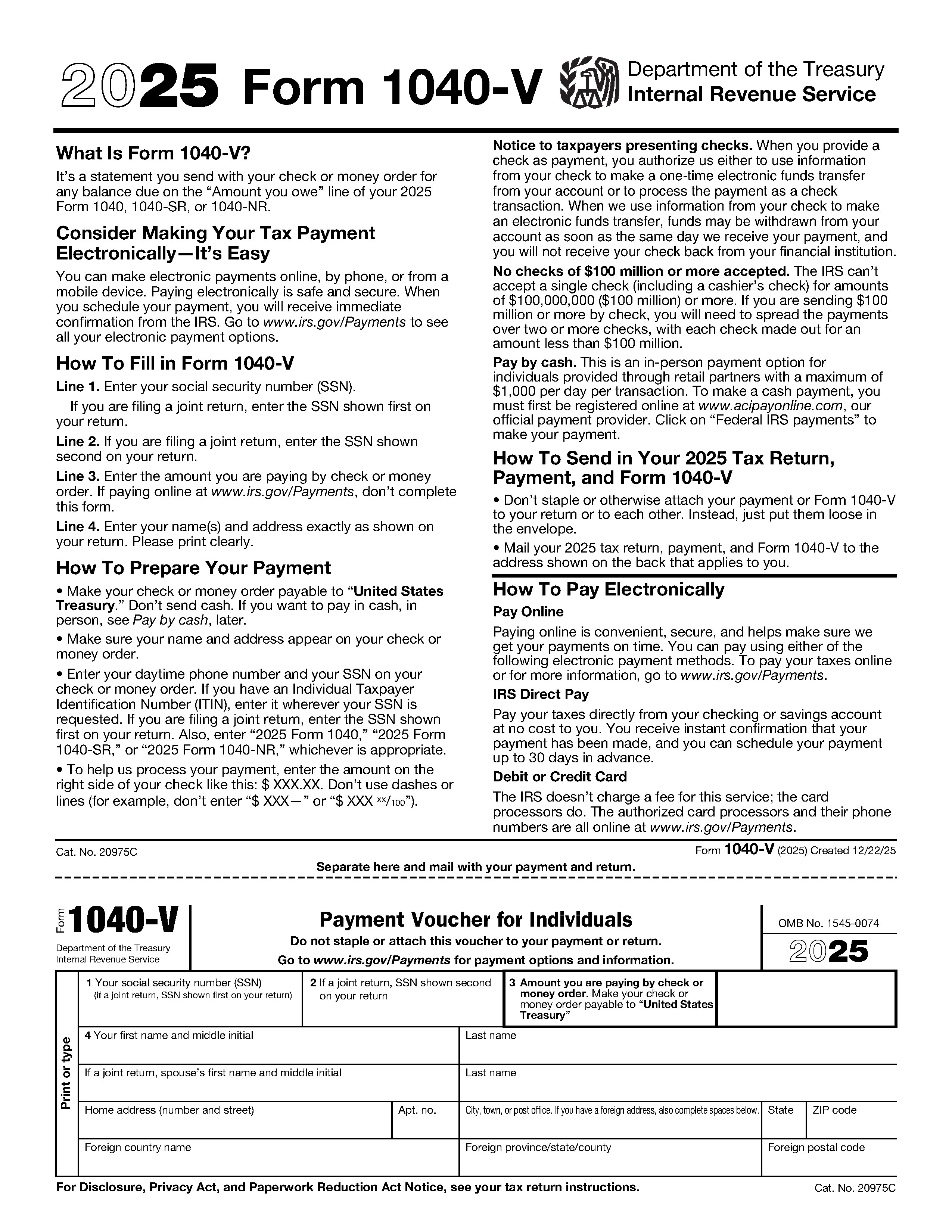
Complete your Form 1040-V - Payment Voucher for Individuals in 3 easy steps
Fill and edit template
Sign it online
Export or print immediately
What Form 1040-V is
Form 1040-V, Payment Voucher for Individuals, is a short slip that travels with your check or money order when you pay a balance due on your federal return by mail. According to the IRS, it accompanies a payment for the "Amount you owe" line of Form 1040, 1040-SR or 1040-NR. The 2025 edition has two pages. The first page holds the instructions and the voucher itself, and the second page holds the payment mailing addresses by region.
The voucher helps the IRS match your payment to your account. It is not a tax return, and it does not change what you owe.
Who typically needs it
- Filers who mail a paper return and pay the balance by check or money order.
- Taxpayers who e-file but choose to mail a check for the balance.
- Late payers who are settling a 2025 balance by check.
If you pay online, by phone or from a mobile device, the form says not to complete it. The IRS lists the electronic options, including IRS Direct Pay, your online account and card payments, at www.irs.gov/payments.
What you need before you start
- Your completed return, so that names, address and balance match exactly.
- The Social Security number shown first on the return, and the second one if you file jointly. If you have an ITIN, use it wherever an SSN is requested.
- The amount of your check or money order.
- Your home address as shown on the return, including foreign address details if they apply.
How to fill out Form 1040-V online with PDF Editify
- Open this template page and click "Fill Template Now".
- The voucher opens in the editor with its fields ready to type into. Click a field and type.
- Download the finished PDF. Downloading needs a plan: One Week Plan at $3 one-time, Standard at $10 per month or $100 per year, or Lifetime from $99 one-time.
- Print the voucher, because it is mailed on paper together with your payment.
Line 1: Your Social Security number
Enter your SSN. On a joint return, enter the SSN shown first on your return.
Line 2: Second SSN on a joint return
Fill this in only for a joint return, using the SSN shown second on the return. Leave it blank otherwise.
Line 3: Amount you are paying
Enter the amount of the check or money order, which must be payable to "United States Treasury". The IRS asks you to write the amount on the check as $ XXX.XX, without dashes or lines such as "$ XXX--" or "$ XXX xx/100".
Line 4: Name and address
Enter your first name and middle initial, last name, and your spouse's name if the return is joint. Then enter the home address (number and street, apartment number, city or post office, state and ZIP code). If you have a foreign address, complete the foreign country, province or state, and postal code spaces as well. Use the name and address exactly as they appear on your return.
Signing and submitting
The voucher has no signature line, so there is nothing to sign on this form. If you need to sign other documents in the same packet, see sign a PDF online. Prepare the payment as the instructions describe:
- Make the check or money order payable to "United States Treasury". Do not send cash.
- Write your name, address, daytime phone number and SSN on the check, plus "2025 Form 1040", "2025 Form 1040-SR" or "2025 Form 1040-NR", whichever applies.
- Do not staple or attach the payment or the voucher to your return or to each other. Put them loose in the envelope.
- Mail them to the address on page 2 that matches where you live. For example, the form lists P.O. Box 1214, Charlotte, NC 28201-1214 for several southeastern states, and P.O. Box 931000, Louisville, KY 40293-1000 for most other states.
The official PDF is at irs.gov/pub/irs-pdf/f1040v.pdf, and the IRS page for the form is About Form 1040-V.
Deadlines and fees
Form 1040-V has no deadline of its own. It goes in the same envelope as your return and payment, so the date that matters is the due date of the return the balance belongs to. Check that date on the IRS site. The IRS charges no fee for the form. It states that Direct Pay costs nothing, and that card payments carry processing fees charged by the processors, not by the IRS. The IRS cannot accept a single check of $100 million or more, and the cash option is limited to $1,000 per day per transaction. Source: IRS Form 1040-V (2025), checked on October 23, 2026.
Common mistakes
- Completing the voucher and also paying online. If you pay electronically, do not send the voucher.
- Stapling the voucher to the check or the return.
- Entering a name or address that differs from the return.
- Using the wrong mailing address from page 2.
- Leaving the SSN and tax year off the check.
Official source: Internal Revenue Service · Version: 2025
Forms, deadlines and fees change. Check that you are using the current version on the official website before you submit. This page is not legal or tax advice.
Frequently Asked Questions
What is Form 1040-V?
It is a payment voucher you send with a check or money order for the balance due on your Form 1040, 1040-SR or 1040-NR. Source: IRS Form 1040-V instructions.
Do I need Form 1040-V if I pay online?
No. The form says that if you pay online at irs.gov/payments, you should not complete it.
Who should the check be payable to?
The IRS tells filers to make the check or money order payable to "United States Treasury" and not to send cash.
Should I staple Form 1040-V to my return?
No. The instructions say not to staple or attach the payment or the voucher to your return or to each other, and to put them loose in the envelope.
Where do I mail Form 1040-V?
Use the address on page 2 of the form that matches where you live. The 2025 form lists three payment addresses, including one for foreign addresses and certain filers.
Related Templates

Form W-9 - Request for Taxpayer Identification Number
Used by businesses to collect taxpayer identification information from vendors, contractors, and other payees. Required for reporting payments to the IRS on forms like 1099-MISC.

IRS Form 8822 - Change of Address
IRS Form 8822, "Change of Address," is used by individuals to notify the IRS of a change to their home mailing address, ensuring they receive tax-related correspondence, refunds, and notices.

Form 1040-X - Amended U.S. Individual Income Tax Return
Amended U.S. Individual Income Tax Return is used to correct errors or make updates to a previously filed tax return. Whether you need to revise your income, change your filing status, or claim...

Form W-2 - Wage and Tax Statement
Annual statement that employers must provide to employees and the IRS reporting wages paid and taxes withheld. Essential document for filing individual income tax returns.

Form SS-4 - EIN Application
Used to apply for an Employer Identification Number (EIN), a federal tax identification number for businesses. Required for businesses with employees, partnerships, corporations, and many LLCs.

Form 1040-ES - Estimated Tax for Individuals
Used by individuals to calculate and pay quarterly estimated taxes on income not subject to withholding, including self-employment income, interest, dividends, and rental income.

Form W-4 - Employee's Withholding Certificate
Completed by employees to indicate their tax situation to their employer. Determines the amount of federal income tax to withhold from paychecks based on filing status and allowances.

Form 8822-B - Change of Address or Responsible Party - Business
Form 8822-B notifies the IRS of a new business mailing address, business location, or a change in the entity's responsible party, as required for any business with an EIN.

Form 1040-SR - Tax Return for Seniors
Designed for taxpayers age 65 or older, this version of the standard return features larger print and a simplified standard deduction table to make it easier to read and file manually.

Form 1099-DA - Digital Asset Transactions
Form 1099-DA "Digital Asset Proceeds From Broker Transactions" is a new IRS form designed to report digital asset sales, including crypto, NFTs, and stablecoins, to taxpayers and the IRS.